OpenClaw-RL Explained: What It Is and What It Takes to Run
OpenClaw was previously known as Clawdbot and Moltbot. This guide applies to all versions.
OpenClaw-RL trains a self-hosted model on live conversations. Default setup needs 8 GPUs and CUDA 12.9. Here is what it takes and the single-GPU workarounds.
Key takeaways
- OpenClaw-RL is a self-hosted RL backend that wraps a model behind an OpenAI-compatible API and learns from live agent interactions while still serving responses.
- The core idea is to treat the next state after an action (user reply, tool output, terminal or GUI state change) as a training signal, per the technical report.
- It supports three Track 1 training recipes: Binary RL (GRPO), On-Policy Distillation (OPD), and a Combined method that mixes both.
- The default setup requires 8 high-memory GPUs, CUDA 12.9, Python 3.12, and compile-heavy dependencies like apex and flash-attn.
- Community interest is high, and so is friction: people are excited about real weight updates, skeptical that RL is the first fix for many agent issues, and loud about accessibility (Docker, single GPU, LoRA, low precision).
OpenClaw-RL is a reinforcement learning framework designed to run alongside OpenClaw. It wraps a self-hosted model behind an OpenAI-compatible API, intercepts live multi-turn conversations, and updates model weights in the background while still serving responses. The question isn't whether the premise is interesting. The question is whether it's accessible and practical yet.
Fixes when it breaks. Workflows when it doesn't.
OpenClaw guides, configs, and troubleshooting notes. Every two weeks.
Why OpenClaw-RL matters for self-hosted AI agents
A few concrete reasons it's getting shared:
Real traction, fast. As of 2026-03-12 UTC, the OpenClaw-RL repo shows 1802 stars and 166 forks since the v1 release on 2026-02-26.
A crisp, memorable claim. The technical report starts with an idea most agent builders already recognize: every agent interaction generates a next-state signal. That's the premise for the whole system.
A repeatable pain point. The issue tracker quickly converged on the same blockers: multi-GPU defaults, hard setup, Docker requests, and "can I do this on one GPU." Issue #11 and Issue #13 each hit the same friction.
Visible shipping cadence. The README News section calls out a v1 release (2026-02-26), a technical report release (2026-03-10), and "Huge updates" that include a combined method and Track 2 method folders.
What is OpenClaw-RL and how does it work
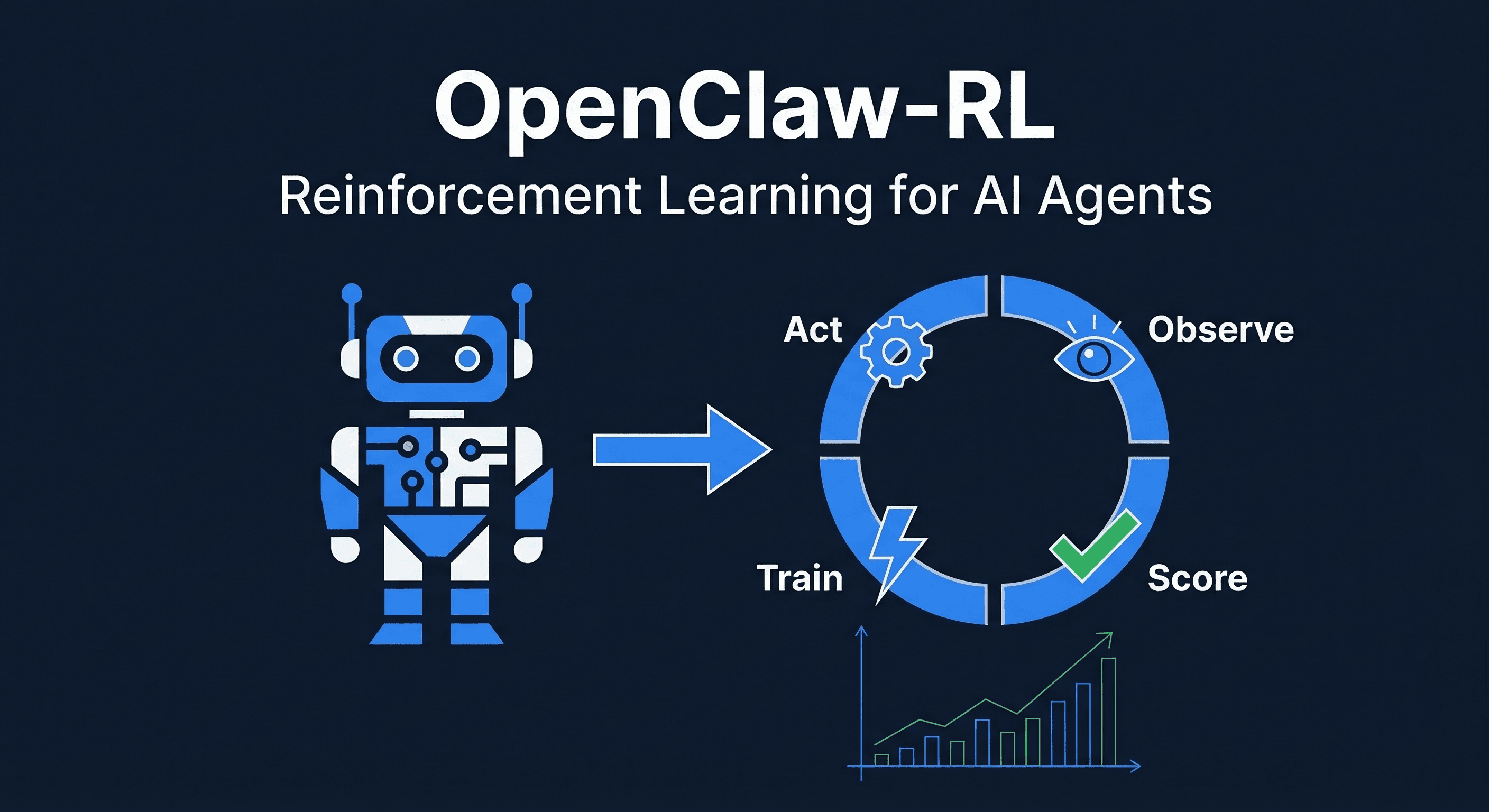
OpenClaw-RL is a "fully asynchronous reinforcement learning framework" that wraps a self-hosted model behind an OpenAI-compatible API, intercepts live multi-turn conversations, and optimizes the policy in the background without blocking the user-facing API.
How does it keep training without blocking responses? It splits work into parallel loops:
- Agent serving (your normal chat and tool use)
- Rollout collection (saving the interaction trajectory)
- PRM or judge evaluation (scoring outcomes)
- Policy training (updating weights)
None of those loops have to block the user-facing API. That's the core architectural claim.
How OpenClaw-RL next-state signals replace human feedback
After an agent takes an action, the world pushes back: a user replies, a tool returns success or an error, a terminal command exits non-zero, a GUI action changes the screen.
The technical report calls that the "next-state signal" and argues it encodes two useful kinds of learning signal:
- Evaluative signals: how well the action worked (scalar rewards via a PRM judge)
- Directive signals: how the action should have been different (hindsight hints via OPD)
OpenClaw-RL training modes: Binary RL, OPD, and Combined
OpenClaw-RL ships three "personal agent optimization" recipes.
1) Binary RL (GRPO)
Binary RL turns feedback into a coarse label: good, bad, or neutral. A PRM/judge provides the score, and the policy is optimized with a PPO-style objective. Details in the Binary RL README.
2) OPD (On-Policy Distillation)
OPD is for cases where the feedback isn't just "bad", but "bad because you should have done X".
It extracts a short hint from the next state, builds a richer teacher context, and trains the student using a token-level directional signal (teacher-student logprob gap). Per the technical report and the project page.
3) Combined (Binary RL + OPD)
The Combined method runs both simultaneously. Binary RL gives broad, cheap coverage; OPD gives higher-resolution corrections when directive feedback exists. Per the Combined README.
What you can do with OpenClaw-RL
The README positions two tracks:
- Track 1: personal agent optimization
- Track 2: "general agents optimization" for terminal, GUI, SWE, and tool-call settings
So what does that actually mean for someone running OpenClaw? The interesting promise isn't "chat better." It's:
- Learn your preferences through repeated corrections
- Improve tool choice order over time
- Improve multi-step planning and recovery when tools fail
- Adapt to feedback that only appears after an action lands in the real world
If your agent repeats mistakes that better memory and skill design could fix, that's not the use case for RL. Where OpenClaw-RL becomes interesting is when the failure pattern lives deeper in the model's reasoning itself, where prompt changes don't reach.
Requirements and the OpenClaw-RL reality check
This is where most people bounce. What does it actually take to run this?
The default assumption is multi-GPU
A community feature request summarizes the barrier directly:
"Current OpenClaw-RL requires 8× GPUs with high memory, which is a significant barrier"
Source: Issue #11
Setup is compile-heavy (CUDA 12.9, Python 3.12, apex, flash-attn)
The setup instructions are explicit about versions. This is the install list to expect:
- CUDA 12.9 (
nvcc -Vandnvidia-smichecks required) conda create --name openclaw-rl python=3.12- PyTorch pinned to CUDA 12.9 wheels:
torch==2.9.1+cu129,torchvision==0.24.1+cu129,torchaudio==2.9.1+cu129 - DeepEP (editable install)
- int4 QAT kernels (editable install)
- NVIDIA apex (built from source)
flash-attn==2.7.4.post1flashinfer-jit-cache==0.5.3(from a CUDA 12.9 wheel index)python3-aptviaapt-get
Community friction matches the setup cost
A Docker request is blunt about why people ask:
"Setting up OpenClaw-RL requires CUDA 12.9, Python 3.12, multiple dependencies, GPU driver configuration. This can be error-prone and time-consuming."
Source: Issue #13
Can you run OpenClaw-RL on 8GB VRAM?
If you mean "run the default RL training loop in the repo", the honest answer is: not realistically.
This isn't just about fitting model weights. It's the combination of serving, rollouts, judging, and training simultaneously, plus long contexts and throughput requirements.
Step 1: Do you actually need weight updates?
If your problem is that the agent forgets preferences, repeats boilerplate, or fails on a specific workflow, that's often fixable with better memory files and skill design. A well-structured AGENTS.md solves a large class of "my agent keeps doing the wrong thing" problems before RL enters the picture.
As one public writeup put it: "To be fair, a lot of agent behavior can already be improved through better memory and skill design." (Avi Chawla on LinkedIn)
Step 2: If you want personalization on small hardware, consider training-free loops
An open, unmerged PR proposes a "zero-GPU experience loop" that doesn't update weights. It's persistent hint extraction and injection:
"intercept → extract hint → store → inject → repeat"
Source: PR #6
That's not RL, but it delivers the same user-visible goal: fewer repeated mistakes.
Step 3: If you want actual training, watch the LoRA and low-precision work
The repo lists "LoRA & low-precision examples" as a highly wanted contribution. Community members are pushing on it:
"Opening this issue to discuss adding the support for LoRA and low-precision training & inference."
Source: Issue #19
The maintainer's response: "LoRA seems to have a much more significant impact when it comes to supporting larger models." (yinjjiew comment)
And from early testing: "I'm using 4 H200 gpus; sometimes it will OOM." (zjysteven comment)
If it's OOM-ing on serious hardware in early testing, 8GB VRAM isn't realistic today.
OpenClaw-RL limitations and async design trade-offs
OpenClaw-RL is research code. Worth being clear-eyed about what that means.
The maintainer's explanation about teacher top-k vs student top-k in OPD distillation illustrates this. Async rollouts constrain what can be pushed through the pipeline:
"In our implementation, we intentionally use teacher top-K as an engineering trade-off due to our asynchronous rollout architecture."
Source: yinjjiew comment
When asked for theoretical justification, the maintainer is candid: "proving it theoretically is hard." (yinjjiew comment)
This isn't a criticism. Treat it as an evolving research stack, not a production-ready product. The approximation choices are intentional and documented. But go in knowing they exist.
OpenClaw-RL community feedback and early adoption
This is a snapshot of repeated themes from a public LinkedIn post and the repo's issue tracker.
Excitement: "It finally updates weights"
"OpenClaw Agents adapt through memory files and skills, but the base model weights never actually change. OpenClaw-RL solves this!"
Source: Avi Chawla (LinkedIn)
Skepticism: "RL is not the first fix"
"To be fair, a lot of agent behavior can already be improved through better memory and skill design."
"Where RL becomes interesting is when the failure pattern lives deeper in the model's reasoning itself."
Source: Avi Chawla (LinkedIn)
Friction: "This is expensive and hard to install"
"Current OpenClaw-RL requires 8× GPUs with high memory, which is a significant barrier"
Source: Issue #11
"This can be error-prone and time-consuming."
Source: Issue #13
Accessibility roadmap: LoRA, low precision, single GPU
"Opening this issue to discuss adding the support for LoRA and low-precision training & inference."
"LoRA seems to have a much more significant impact when it comes to supporting larger models."
Source: Issue #19 and maintainer response
Engineering reality: async trade-offs show up in the details
"In our implementation, we intentionally use teacher top-K as an engineering trade-off due to our asynchronous rollout architecture."
Source: yinjjiew comment, Issue #7
Pragmatism: people will take a weaker substitute if it's usable
"intercept → extract hint → store → inject → repeat"
Source: PR #6
Who should use OpenClaw-RL and who should wait
Should you run this today? It depends heavily on your setup.
You should pay attention if
- You already run agents that act in the world (terminal, code, tools) and you have stable evaluation signals.
- You have infrastructure for RL as a system: GPUs, observability, and rollback.
- You're hitting a ceiling where prompt changes don't fix repeated reasoning or planning failures.
You should probably skip it for now if
- You have one consumer GPU and you just want "my agent remembers me." Better memory design solves that without multi-GPU infrastructure.
- You're not prepared to secure and monitor a service collecting and learning from interaction traces.
- You want a turnkey product. This is research-grade engineering.
Key terms
OpenClaw-RL is a fully asynchronous reinforcement learning framework that wraps a self-hosted model behind an OpenAI-compatible API and learns from live multi-turn agent interactions while still serving responses.
Next-state signal is the feedback generated after an agent action: a user reply, tool output, terminal exit code, or GUI state change. OpenClaw-RL uses these signals as the primary training source.
Track 1 covers three personal agent training methods: Binary RL (GRPO), On-Policy Distillation (OPD), and Combined.
PRM judge is a Process Reward Model that scores agent actions for Binary RL, providing the evaluative signal used to train the policy.
OPD (On-Policy Distillation) extracts hindsight hints from the next state and trains the student model using a token-level directional signal (teacher-student logprob gap).
LoRA (Low-Rank Adaptation) is a parameter-efficient fine-tuning method that trains adapter weights rather than full model weights, dramatically reducing VRAM requirements. Not yet available in the default OpenClaw-RL setup as of early 2026.
FAQ
What is OpenClaw-RL and how is it different from regular OpenClaw?
OpenClaw is an AI agent platform that customizes behavior through memory files, skills, and prompt design. The base model weights never change. OpenClaw-RL adds a reinforcement learning layer that actually updates model weights based on live interactions. It's a separate self-hosted system that wraps a model behind an OpenAI-compatible API and runs RL training loops in the background while serving requests.
What hardware does OpenClaw-RL require to run?
The default setup requires 8 high-memory GPUs with CUDA 12.9, Python 3.12, and several compile-heavy dependencies including NVIDIA apex, flash-attn 2.7.4, and flashinfer. This is a multi-GPU research setup, not consumer hardware. LoRA and single-GPU support are actively requested by the community but not available in the default configuration as of early 2026.
Can OpenClaw-RL run on a single consumer GPU with 8GB VRAM?
Not with the default training loop. The setup requirements assume 8 high-memory GPUs, and early community testing has run out of memory on 4 H200 GPUs. A training-free alternative exists as PR #6, which extracts and injects hints without updating weights. That runs lighter, but it's not RL.
What are the three training modes in OpenClaw-RL Track 1?
OpenClaw-RL Track 1 includes three training methods for personal agent learning. Binary RL (GRPO) uses a PRM judge to assign coarse reward labels and trains with a PPO-style objective. On-Policy Distillation (OPD) extracts hindsight hints from the next state and trains using a token-level directional signal. The Combined method runs both simultaneously for broad coverage plus high-resolution corrections.
When should I use OpenClaw-RL instead of improving OpenClaw memory and skills?
Start with OpenClaw memory and skills if the agent forgets preferences, repeats boilerplate, or fails on specific workflows. Those issues are fixable without RL and without multi-GPU infrastructure. OpenClaw-RL becomes relevant when the failure is in the model's reasoning itself, when better prompts and memory don't fix it, and when you have the GPU infrastructure and evaluation signals to run RL properly.
Quick reference
- Repo: Gen-Verse/OpenClaw-RL
- Technical report (arXiv 2603.10165)
- Project page
- Setup instructions
- Combined method README
OpenClaw was previously known as Clawdbot and Moltbot before settling on its current name.
Changelog
| Date | Change |
|---|---|
| 2026-03-12 | Initial draft |
| 2026-03-13 | Citations reformatted to inline links; post_type corrected to news; FAQ and Key terms added |
Fixes when it breaks. Workflows when it doesn't.
OpenClaw guides, configs, and troubleshooting notes. Every two weeks.