7 Best OpenClaw Alternatives in 2026 (Lightweight, Cloud, and Self-Hosted)
OpenClaw was previously known as Clawdbot and Moltbot. This guide applies to all versions.
Compared: PicoClaw, nanoClaw, ArkClaw, IronClaw, and more. Which OpenClaw alternative fits your setup, budget, and hardware in 2026.
Key takeaways
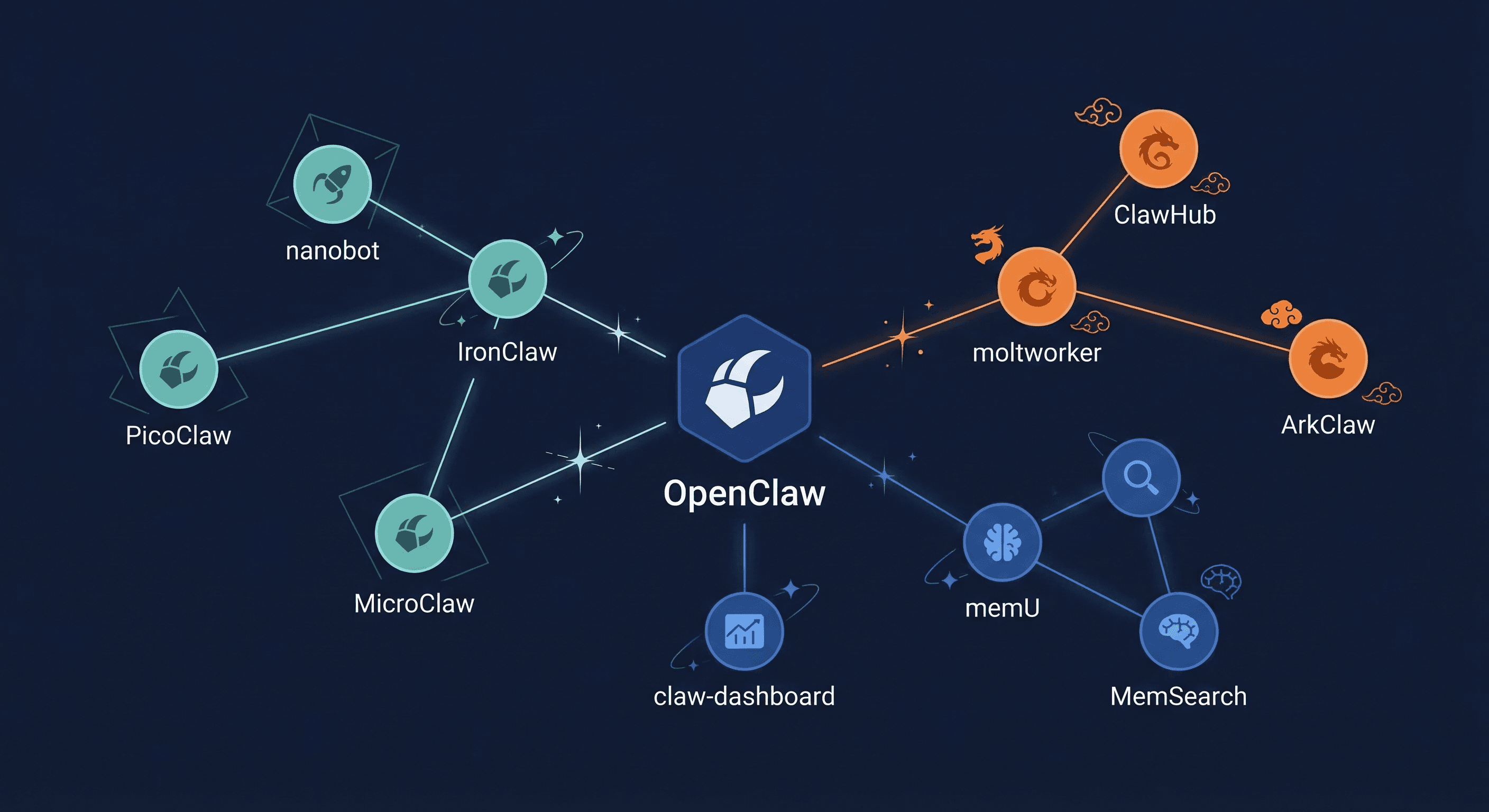
- OpenClaw has generated a broad ecosystem of lightweight runtimes, deployment tools, memory libraries, and skill registries
- Verified lightweight alternatives include nanobot, PicoClaw, nanoClaw, MicroClaw, and IronClaw
- moltworker is a Cloudflare-authored proof-of-concept for running OpenClaw inside Cloudflare's Sandbox environment
- ClawHub is the official skill registry; awesome-openclaw-skills and awesome-openclaw-usecases are the main community catalogs
- memU and MemSearch bring pluggable, markdown-first memory to OpenClaw-style agents
- The "lobster fever" wave of March 2026 produced Chinese cloud variants from ByteDance, Tencent, Zhipu AI, Moonshot, and Baidu
- OpenClaw usage in China surpassed US usage by early March 2026
OpenClaw started as a personal assistant framework, but the community didn't stop there. Developers have built lightweight runtimes for low-power hardware, memory plugins, monitoring dashboards, skill registries, and cloud-hosted variants from some of China's largest tech companies. This is a map of what exists, organized by category.
Fixes when it breaks. Workflows when it doesn't.
OpenClaw guides, configs, and troubleshooting notes. Every two weeks.
OpenClaw lightweight runtime alternatives
The lightweight alternatives are separate projects, not forks. Each one is independently developed, but they all share the same core idea: a chat-surface agent that reads markdown files and executes code. They differ mainly in language, footprint, and security posture.
PicoClaw
PicoClaw is an ultra-lightweight personal assistant written in Go. It compiles to a single binary and targets very low-resource hardware, claiming 10-20MB of RAM in typical operation. It runs on RISC-V, ARM, MIPS, and x86, which makes it a real option for embedded systems and small single-board computers. The project positions itself within the "nano lineage" and directly cites nanobot as an inspiration. It's not an OpenClaw fork, but the design goals clearly overlap.
Who it's for: developers who want an OpenClaw-style agent on constrained hardware without installing a Node.js runtime.
nanobot
nanobot is a Python-based personal AI assistant that describes itself explicitly as "inspired by OpenClaw." It's minimal by design, with a small code footprint, multi-channel support, and MCP (Model Context Protocol) integration. The project emphasizes fast iteration and is aimed at developers who want to build or customize their own agent without working through a larger codebase. If you're comfortable in Python and find OpenClaw's Node.js foundation inconvenient, nanobot is the most direct starting point.
nanoClaw
nanoClaw takes a similar starting point to nanobot but shifts the focus toward security. It includes sandboxing, command filtering, and prompt injection defenses that you won't find in a standard OpenClaw install. The project describes itself as "ultra-lightweight secure AI assistant inspired by OpenClaw." It's Python-based and targets more exposed environments: shared servers, machines you don't fully control, or setups where the default OpenClaw security posture isn't enough.
MicroClaw
MicroClaw is written in Rust and takes a channel-agnostic approach to the agent architecture. It ships with platform adapters for Telegram, Discord, Slack, and others, plus built-in tools for shell access, file operations, and web requests. It also includes persistent memory and installation helpers. The project cites nanoClaw's design ideas rather than OpenClaw directly, but it's clearly in the same family. The Rust implementation means lower memory usage and no garbage collection pauses, which matters if you're running this on a low-memory server.
IronClaw
IronClaw is listed in the awesome-claws meta-index as a Rust-based, privacy-focused OpenClaw-inspired project by the nearai organization. The GitHub repository was intermittently returning 502 errors during research, so the following details should be independently verified. Based on available information, the project prioritizes keeping agent operations local and minimizing data exposure.
Unverified lightweight projects
Note: there is a separate TypeScript project also called NanoClaw, distinct from the Python nanoClaw by ysz described above. The two share a similar name but are independent projects.
The awesome-claws meta-index lists additional projects, including TinyClaw, NanoClaw (TypeScript), NullClaw, Moltis, and ZeptoClaw. These haven't been individually verified via their primary GitHub pages at the time of writing. Treat them as leads rather than confirmed projects until you can check the repos directly.
OpenClaw deployment tools: running on Cloudflare Workers
Getting OpenClaw to run as a managed, always-on service is one of the harder deployment problems. moltworker is the most complete solution available right now.
moltworker packages OpenClaw to run inside Cloudflare's Sandbox and Containers environment. It's a proof-of-concept from Cloudflare itself, which gives it some credibility. The setup includes Cloudflare Access protection for the endpoint and optional persistence, meaning your agent's memory and state can survive across invocations. It's not a production-hardened deployment system, but it gets you from "running OpenClaw locally" to "running OpenClaw in a managed cloud environment" with less effort than building your own infrastructure.
Who it's for: developers who want to host an OpenClaw instance without managing a server. You get the Cloudflare network, DDoS protection, and Access-based authentication as part of the package.
OpenClaw skill registries and community directories
Skills are how you extend what OpenClaw can do. The registry ecosystem has grown quickly.
ClawHub (official registry)
ClawHub is the official public registry for OpenClaw skills. It handles publishing, versioning, and search, and includes a vector search layer for finding skills by description. The registry also has moderation hooks and supports a parallel "SOUL.md registry" for agent personality definitions (SOUL.md is a markdown file that defines an agent's tone and personality, similar to how AGENTS.md defines behavior rules). If you've written a skill and want to share it, ClawHub is the standard place. The OpenClaw CLI integrates with ClawHub directly.
awesome-openclaw-skills
awesome-openclaw-skills is a community-curated list of skills sourced from ClawHub. It's organized by category and is a discovery surface for skills that might not surface easily through search. Think of it as a hand-picked subset of the registry, with community signal on what's actually useful.
awesome-openclaw-usecases
awesome-openclaw-usecases takes a different approach. Instead of listing skills, it documents automation patterns built with OpenClaw. Examples include digest pipelines, self-healing server scripts, and event-driven workflows. It's more useful when you're trying to figure out what's possible than when you're looking for a specific skill to install.
awesome-claws
awesome-claws is a meta-index of OpenClaw-adjacent and OpenClaw-inspired agent projects. It's a useful discovery tool for the broader ecosystem, though the individual entries vary in quality and current maintenance status. Verify each project directly before treating it as production-ready.
OpenClaw memory libraries
OpenClaw's markdown-first memory design, where the agent reads and writes plain text files rather than a database, has inspired at least two standalone memory libraries.
memU
memU is a memory framework built explicitly "for 24/7 always-on agents like OpenClaw." It uses a memory-as-filesystem metaphor, organizing agent memories as files with structured metadata. The main design goal is reducing the cost of long-running agents. Rather than sending your entire memory context with every API call, memU handles retrieval so only the relevant memories are included. It also includes background intent capture, meaning it can surface relevant past context without an explicit query.
Who it's for: anyone running an OpenClaw instance continuously and hitting token costs from large context windows.
MemSearch
MemSearch is from Zilliz, the company behind Milvus, and takes a more infrastructure-oriented approach. It's a markdown-first semantic memory library that directly ports OpenClaw's memory architecture into a reusable, pluggable library. Features include deduplication hashing, file watcher sync (so memory updates happen automatically when files change), and support for swappable embedding backends. The project ships with a Claude Code plugin example that shows how to wire it into an existing agent setup.
MemSearch is the more mature of the two. It comes from an established infrastructure company and has a cleaner API surface. memU is closer in spirit to OpenClaw's original approach.
OpenClaw monitoring and operational tools
When you're running an OpenClaw instance, or several, you need some way to see what's happening.
claw-dashboard is a terminal dashboard for monitoring OpenClaw instances. It shows real-time session tracking and agent status, and includes a security audit widget that surfaces unusual activity. The design is system-monitor style, similar to tools like htop or btop, but focused on OpenClaw sessions rather than system resources. If you're managing more than one agent or running OpenClaw on a server you access remotely, claw-dashboard gives you a single view of what's active.
It's a community project, not an official OpenClaw tool. But it's the closest thing to operational monitoring that currently exists in the ecosystem.
Chinese OpenClaw cloud derivatives and the lobster fever wave
In early March 2026, more than a dozen Chinese technology companies launched cloud versions of OpenClaw in a matter of days. The wave has been described informally as "lobster fever," a play on the claw imagery. By March 12, 2026, CNBC was covering it as a significant consumer technology trend, noting that OpenClaw usage in China had surpassed usage in the United States, per CNBC's reporting citing SecurityScorecard and declawed.io data.
The scale of adoption is notable. Yicai Global reported that the top three tools on OpenRouter used by OpenClaw users were all Chinese companies, with combined usage roughly double that of the top Google Gemini and Anthropic Claude models in the same period.
The major Chinese variants break down like this:
QClaw (Tencent): Tencent's suite of OpenClaw products, internally called "lobster special forces," integrates directly with WeChat. It's aimed at Tencent's existing WeChat user base.
AutoGLM Claw (Zhipu AI): A local OpenClaw variant that ships with more than 50 pre-installed skills and a one-click installation process. The low-friction setup is the main differentiator.
Kimi Claw (Moonshot AI): An OpenClaw variant from Moonshot AI, the makers of the Kimi model series.
Baidu AI Cloud version: Baidu's deployment has a visual four-step setup process and includes AI search and the Qianfan deep research agent as pre-installed skills.
JD.com: Maintains a dedicated OpenClaw setup page for its users.
Multiple companies held in-person setup events during this period. Tencent ran a free session in Shenzhen that reportedly drew hundreds of attendees.
ArkClaw by ByteDance: Feishu integration, pricing, and data location
ArkClaw is the most fully developed of the Chinese cloud variants. It launched on March 9, 2026 and is built on ByteDance's Volcano Engine cloud platform.
The default model is Doubao-Seed-2.0, ByteDance's own model. It also supports Kimi 2.5 (Moonshot AI), MiniMax 2.5 (MiniMax), and GLM (Zhipu AI) as third-party alternatives. The standout feature is deep integration with Feishu (also known as Lark), ByteDance's enterprise productivity suite. ArkClaw can read and write Feishu documents, work with spreadsheets, summarize meeting minutes, and interact with calendar and scheduling features. For teams already using Feishu, this makes ArkClaw more directly useful than running a self-hosted OpenClaw instance with manual integrations.
Pricing is ¥8.9 per month (approximately $1.20 USD) for the Pro Plan, with a seven-day free trial. All data lives on Volcano Engine's infrastructure in China. That's a relevant consideration for users outside China or companies with data residency requirements.
ArkClaw is not open source. It's a commercial SaaS product built on top of the OpenClaw codebase. For a deeper comparison of the two, see the OpenClaw vs ArkClaw article on this site.
Key Terms
OpenClaw: Open-source personal AI agent runtime built on top of large language models. Runs on chat surfaces like Telegram and Discord, and reads markdown files for memory and configuration.
ClawHub: The official public registry for OpenClaw skills. Handles publishing, versioning, and discovery, including vector search.
moltworker: A Cloudflare-authored proof-of-concept that packages OpenClaw for deployment inside Cloudflare's Sandbox and Containers environment.
nanobot: A lightweight Python AI assistant explicitly inspired by OpenClaw. Minimal footprint, multi-channel support, and MCP integration.
memU: A memory framework built for always-on agents, using a file-system metaphor and retrieval-based context management.
MemSearch: A markdown-first semantic memory library from Zilliz that ports OpenClaw's memory architecture into a reusable library.
ArkClaw: ByteDance's commercial cloud SaaS version of OpenClaw, running on Volcano Engine with deep Feishu integration.
Lobster fever: Informal name for the March 2026 wave of Chinese cloud derivatives of OpenClaw, referencing the claw imagery of the original project.
FAQ
What is the difference between OpenClaw and nanobot?
OpenClaw is the original project: a full-featured personal AI agent runtime with a skill system, memory, and multi-channel support, written in TypeScript/Node.js. nanobot is a separate, independently maintained Python project that was inspired by OpenClaw but is significantly smaller in scope. nanobot targets developers who want a minimal starting point or who prefer Python. It's not a fork and doesn't share OpenClaw's codebase.
Is ArkClaw an official fork of OpenClaw?
ArkClaw is a commercial product from ByteDance that uses the OpenClaw codebase, but it's not an official fork and isn't maintained by the OpenClaw team. OpenClaw is open-source; ArkClaw is a proprietary SaaS product built on top of it. The two projects are not affiliated.
Does OpenClaw have an official skill registry?
Yes. ClawHub is the official public registry for OpenClaw skills. The OpenClaw CLI integrates with it directly. You can also browse skills through awesome-openclaw-skills, a community-curated catalog sourced from ClawHub.
Can OpenClaw run on Cloudflare Workers?
Yes, with moltworker, a proof-of-concept package from Cloudflare itself. It runs OpenClaw inside Cloudflare's Sandbox and Containers environment, with Cloudflare Access for authentication and optional state persistence. It's a proof-of-concept, not a production deployment system, but it works.
What caused the Chinese OpenClaw derivative wave in March 2026?
The wave, informally called "lobster fever," came quickly after OpenClaw gained significant traction in China. By early March 2026, OpenClaw usage in China had surpassed usage in the United States according to SecurityScorecard and declawed.io. Chinese tech companies moved fast to offer cloud-hosted, managed versions with local data residency and integrations with Chinese productivity platforms like WeChat and Feishu.
What is MemSearch and how does it relate to OpenClaw?
MemSearch, from Zilliz, is a standalone markdown-first semantic memory library that explicitly ports OpenClaw's memory architecture into a reusable package. It's not part of OpenClaw itself, but it's designed to work with OpenClaw-style agents. It adds deduplication, file watcher sync, and pluggable embedding backends to the basic markdown-memory pattern.
Evidence & Methodology
This article covers the OpenClaw ecosystem as of March 2026. All project details were sourced from primary GitHub repositories. Projects in the unverified leads list could not be confirmed via their repository pages at time of writing due to transient errors or missing pages; they're included as leads, not verified entries.
OpenClaw was previously known as Clawdbot (November 2025) and Moltbot (January 2026) before adopting the current name, as noted in the CNBC coverage.
OpenClaw's GitHub star count of 280,000+ reflects its position as one of the most-starred open-source AI agent projects. Peter Steinberger, the creator, joined OpenAI in mid-February 2026.
Chinese usage statistics, including the claim that OpenClaw usage in China surpassed the US, are sourced from CNBC's March 12, 2026 report citing SecurityScorecard and declawed.io data. ArkClaw pricing and model details are sourced from an independent ArkClaw product review. Chinese tech company launches are sourced from Yicai Global.
Related Resources
- OpenClaw Persistent Memory Guide: covers the markdown memory system that memU and MemSearch are built to extend
- How to Write an Effective AGENTS.md for OpenClaw: foundational reading if you're setting up any of these projects
- OpenClaw CLI Commands Reference: useful for working with ClawHub from the terminal
- OpenClaw vs ArkClaw: deeper comparison of the original and ByteDance's commercial variant
- OpenClaw System Prompt Design Guide: relevant if you're adapting skills for any of the lightweight runtimes
Changelog
| Date | Change |
|---|---|
| 2026-03-13 | Initial publication |
Fixes when it breaks. Workflows when it doesn't.
OpenClaw guides, configs, and troubleshooting notes. Every two weeks.