OpenClaw vs ArkClaw: Self-Hosted Agent or ByteDance Cloud?
OpenClaw was previously known as Clawdbot and Moltbot. This guide applies to all versions.
OpenClaw vs ArkClaw compared: pricing, models, data privacy, and channel support. Self-hosted control versus ByteDance managed cloud with Feishu integration.
Key takeaways
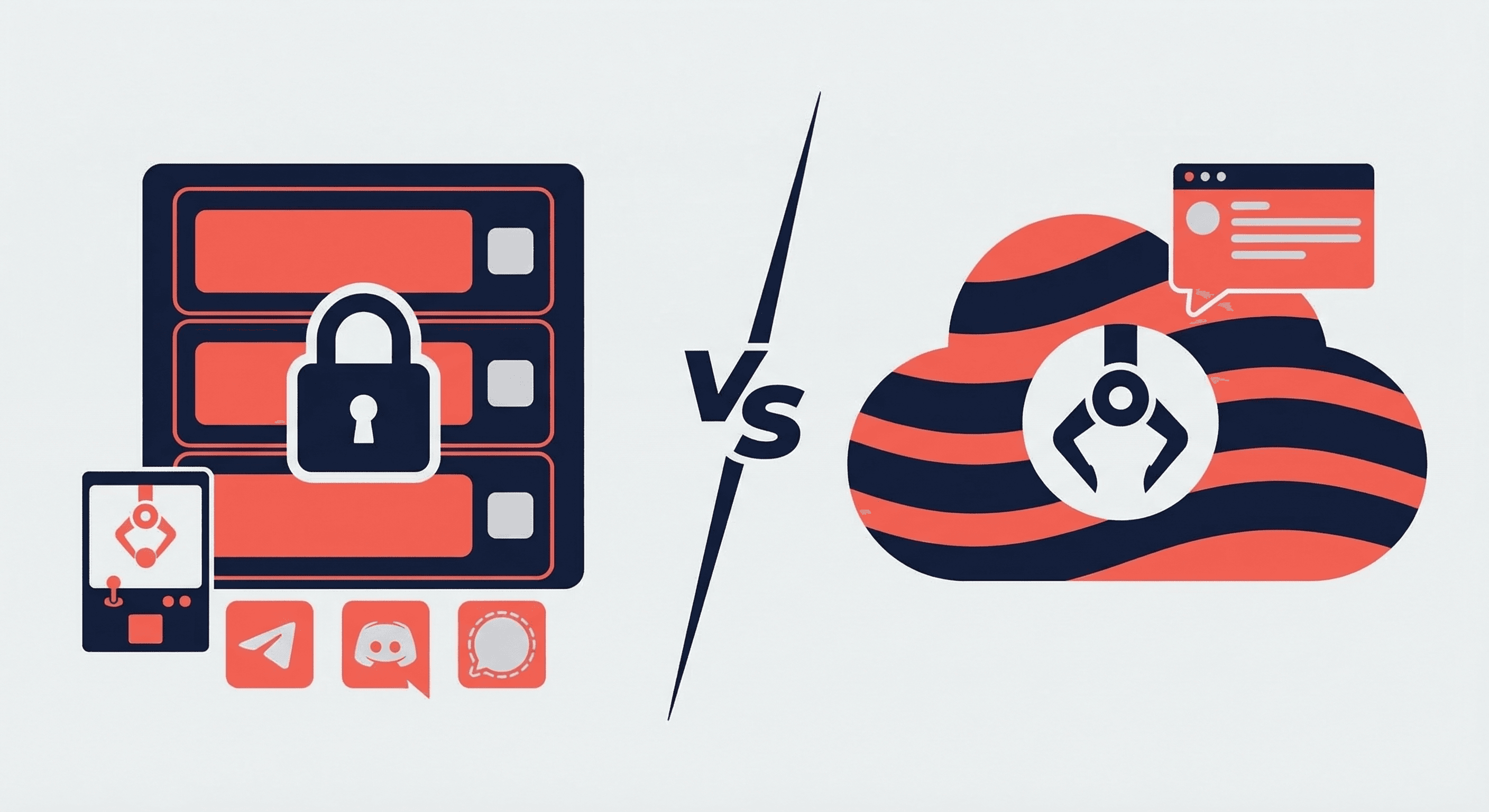
- ArkClaw is ByteDance's managed cloud version of OpenClaw, running on Volcano Engine infrastructure in China. OpenClaw is the self-hosted original with full model choice and data on your server.
- ArkClaw only supports Chinese-developed models: ByteDance's Doubao plus third-party options from Moonshot AI (Kimi), MiniMax, and Zhipu AI (GLM). No OpenAI, Anthropic, or Google.
- For non-Chinese users with data privacy requirements, self-hosted OpenClaw is the safer option. For Chinese teams on Feishu, ArkClaw's native integration and zero-maintenance setup are genuinely useful.
- If an ArkClaw subscription lapses, your instance and data are deleted within 24 hours.
Two products. Same DNA. Very different implications. ArkClaw is OpenClaw packaged as a managed service running on ByteDance's Volcano Engine cloud, available through a web browser with no server setup required. OpenClaw is the original self-hosted framework. This comparison covers what each offers, what you trade away, and who each one actually makes sense for.
Fixes when it breaks. Workflows when it doesn't.
OpenClaw guides, configs, and troubleshooting notes. Every two weeks.
OpenClaw vs ArkClaw: How they differ
ArkClaw is a managed cloud version of OpenClaw, launched March 9, 2026 by Volcano Engine, ByteDance's cloud computing unit. It was one of more than a dozen OpenClaw variants released by Chinese tech companies in early March 2026. Reporters called it "lobster fever", a wave of Chinese adoption that briefly pushed OpenClaw usage in China past that of the US. OpenClaw is the original: self-hosted, open-source, model-agnostic, and running on whatever server you point it at.
The core distinction is infrastructure ownership. With OpenClaw, you provision the server, configure the channels, and manage the data. With ArkClaw, ByteDance's cloud handles all of that. Same underlying agent concept; entirely different ownership model.
Yicai Global described ArkClaw as a "cloud-based SaaS version, deeply integrated with Lark plugins." Lark is the international name for Feishu, ByteDance's enterprise collaboration product. That integration is ArkClaw's biggest selling point, and also its biggest constraint.
OpenClaw vs ArkClaw: Deployment and setup
Setting up ArkClaw takes about a minute. Create a Volcano Engine account, click to spin up an instance, and you're running. No server provisioning, no terminal, no config files. CNBC noted that ArkClaw "can be used in a web browser, eliminating the need for complex local setup."
OpenClaw is more involved. You'll need a server (a VPS, Raspberry Pi, or local machine) and you'll configure channels, API keys, and skills yourself. The official OpenClaw documentation walks through setup, and most technically comfortable users get through it in 15-30 minutes. But it's not a one-click process.
One practical difference: OpenClaw running locally stops when your PC does. ArkClaw runs on dedicated cloud resources that stay up regardless of your machine's state. For users who want an agent that's always available without maintaining a VPS, that's a real advantage.
ArkClaw does have a wrinkle with enterprise accounts. Sub-accounts need IAM (identity and access management) permissions configured before they can access the instance, an extra step that can catch teams off guard during onboarding.
OpenClaw vs ArkClaw: Cost comparison
ArkClaw offers a 7-day free trial on the Lite plan, with a Pro plan starting at ¥8.9 for the first month. Beyond that, you'll also pay Volcano Ark's model API costs on top of the subscription fee. Those costs vary by model and usage volume.
OpenClaw itself is free. Your costs are server costs (a basic VPS runs $5-10/month) and whatever LLM API fees you incur directly. For Claude, GPT-4o, or Gemini, you pay Anthropic, OpenAI, or Google directly.
There's a significant data portability risk with ArkClaw's pricing model worth knowing. If your subscription lapses, your instance is deleted and your data is only retained for 24 hours before it's gone permanently. That's a hard deadline most subscription tools don't impose.
For light personal use with Chinese models, ArkClaw's cost is competitive. If you're running heavy workloads with expensive Western LLMs, self-hosted OpenClaw almost always costs less over time.
OpenClaw vs ArkClaw: Model support and flexibility
OpenClaw works with any LLM provider. Per the OpenClaw documentation, it supports OpenAI, Anthropic, Google, Mistral, and local models through providers like Ollama. You're not locked to any vendor.
ArkClaw defaults to Doubao-Seed-2.0, ByteDance's own model. It also supports Kimi 2.5 (Moonshot AI), MiniMax 2.5 (MiniMax), and GLM (Zhipu AI), with an "Auto" mode that dispatches across those options. All are Chinese-developed, but only Doubao is ByteDance's. The others are third-party models accessed through Volcano Engine's marketplace.
If you need GPT-4o, Claude Sonnet, or Gemini Pro, ArkClaw doesn't offer them. This is a real constraint for users who've built workflows around specific Western LLMs or who prefer Anthropic's safety tuning or OpenAI's code capabilities.
CNBC reported that the top three tools used by OpenClaw users on OpenRouter were all Chinese companies, which suggests Chinese models have plenty of traction in this space. But if your specific use case depends on a model outside that set, the choice is made for you.
OpenClaw vs ArkClaw: Channel integrations
OpenClaw's channel support covers Telegram, Discord, WhatsApp, Signal, iMessage, Slack, IRC, Google Chat, LINE, and others. Nine named channels and counting. You can run the same agent across multiple channels simultaneously.
ArkClaw's channel strategy is different. It's built around Feishu (Lark) as the primary interface, with a web UI as the secondary option. Yicai Global described ArkClaw's Feishu integration as deep: creating and editing docs, managing spreadsheets, writing meeting minutes, and scheduling reminders through Feishu's plugin system. It can also bind to DingTalk and WeCom.
If you live in Feishu, that integration is genuinely useful. The agent becomes part of your existing work environment rather than a separate tool you switch to.
But if you're on Telegram, Discord, or Signal, ArkClaw has nothing to offer on that front. And ArkClaw currently doesn't support mobile web. It's PC and Feishu app only.
OpenClaw vs ArkClaw: Data privacy and sovereignty
This is where the comparison gets serious for non-Chinese users.
ArkClaw runs on Volcano Engine, which is ByteDance's cloud platform. Your agent conversations, uploaded files, and workflow data go through ByteDance-controlled infrastructure in China. CNBC noted that ArkClaw data is on Volcano Engine, ByteDance's cloud unit.
Chinese companies are subject to China's Cybersecurity Law, the Data Security Law, and the Personal Information Protection Law (PIPL). Those laws can require companies to provide data access to Chinese authorities. ByteDance CEO Shou Zi Chew testified before the US House Energy and Commerce Committee in March 2023. His written statement said "ByteDance is not owned or controlled by the Chinese government." Lawmakers were not persuaded, and the data-sharing question has not been resolved.
Chinese officials have raised their own concerns. Yicai Global quoted a CCTV report citing NPC deputy Gao Wen: "the open-source nature of tools like OpenClaw creates a gray area in security responsibility." That's a governance question about accountability when open-source tools are deployed at scale. It's not specific to ArkClaw, but it's relevant to any managed deployment built on OpenClaw's codebase.
OpenClaw is different in this respect. You deploy it. Your data goes on your server. If you run it on a VPS in your own country, or on hardware in your house, the data stays there.
For Chinese teams using ArkClaw within China's regulatory environment, this is a non-issue. For companies in Europe, the US, or other jurisdictions handling sensitive personal or business data, it's a real compliance concern.
OpenClaw vs ArkClaw: Skills and automation capabilities
OpenClaw gives you access to ClawHub, the community skill registry, plus the ability to write and load custom skills. It includes a cron/heartbeat system for scheduled tasks, a browser relay for web automation, and a node system for controlling remote devices. Memory lives as markdown files on your local filesystem.
ArkClaw runs in a sandboxed cloud environment. It doesn't offer the node system, browser relay, or local filesystem access that self-hosted OpenClaw provides. The ArkClaw review notes its focus on Feishu plugin integration rather than the broader skill ecosystem. Custom skill loading wasn't documented at launch.
If your use case is Feishu tasks and conversational work, ArkClaw covers that well. If you rely on custom skills, cron automation, or integrations with local tools, self-hosted OpenClaw is the only option that supports them.
OpenClaw vs ArkClaw: Uptime and maintenance
ArkClaw handles its own infrastructure. It stays up when your machine is off, updates automatically, and requires no server administration from you. You trade control for convenience.
OpenClaw puts you in charge of everything. Server uptime is your responsibility. Updates need to be applied manually or through automation you set up. Failures need to be debugged and fixed. If you're not comfortable with basic server administration, that burden is real.
The flip side: when you run OpenClaw yourself, you know exactly what version is running. You can test updates before applying them. Nothing changes without your action. For anyone who's been burned by a managed tool silently changing behavior, that matters.
OpenClaw vs ArkClaw: Full feature comparison table
| Feature | OpenClaw (self-hosted) | ArkClaw (ByteDance cloud) |
|---|---|---|
| Deployment | Your server, VPS, or Pi | Volcano Engine cloud (China) |
| Setup time | 15-30 min (technical) | ~1 min (click to create) |
| Cost | Server costs + API keys | ~¥8.9 intro month + Volcano Ark API (standard rate not disclosed) |
| Default model | Your choice (any) | Doubao-Seed-2.0 |
| Model flexibility | Any provider | Doubao (ByteDance) + Kimi, MiniMax, GLM (third-party) |
| Channels | Telegram, Discord, WhatsApp, Signal, iMessage, Slack, and more | Feishu primary, web UI |
| ClawHub skills | Full access + custom | Subset only |
| Data location | Your infrastructure | Volcano Engine (China) |
| Uptime | You manage | 24/7 managed |
| Mobile access | Via messaging apps | PC and Feishu app only |
| Data on cancel | Your files stay | Deleted after 24 hours |
| Maintenance | Manual updates, you manage | Auto-updated |
OpenClaw vs ArkClaw: Who should use each one?
Use ArkClaw if:
- You're a Chinese team already working in Feishu
- You want an always-on agent without managing a server
- You're comfortable with ByteDance's cloud infrastructure
- The Chinese model selection (Doubao, Kimi, GLM) fits your use case
The Feishu integration is well-built, and setup takes about a minute.
Use self-hosted OpenClaw if:
- You need a Western LLM (OpenAI, Anthropic, Google)
- You want your agent on Telegram, Discord, Signal, or another non-Feishu channel
- You have data privacy or compliance requirements that rule out Chinese cloud storage
- You want full skill access and automation capabilities
It requires more setup. The tradeoffs are real.
One edge case: if you're evaluating OpenClaw for the first time, ArkClaw's free trial is a fast way to try the general concept. But ArkClaw's model and channel options differ substantially from a self-hosted setup. If you're evaluating for use with Western LLMs or channels like Telegram, the trial won't reflect that experience.
FAQ
What models does ArkClaw support?
ArkClaw supports Doubao-Seed-2.0 (ByteDance, default), Kimi 2.5 (Moonshot AI), MiniMax 2.5 (MiniMax), and GLM (Zhipu AI). It also has an "Auto" dispatch mode. None are Western models. It does not support OpenAI, Anthropic, or Google.
Is ArkClaw safe to use outside China?
It depends on your risk tolerance and what data you're processing. ArkClaw runs on Volcano Engine infrastructure in China, subject to Chinese data laws. For casual personal use, this may not matter. For business data or anything subject to GDPR, evaluate whether Chinese cloud storage is acceptable for your situation.
What happens to ArkClaw data if I cancel my subscription?
Your ArkClaw instance is deleted when the subscription expires. Your data is retained for only 24 hours before permanent removal. Export anything you want to keep before the subscription ends.
Can I use OpenClaw on Feishu instead of ArkClaw?
OpenClaw supports many messaging channels, but its Feishu integration doesn't match what ArkClaw provides. If Feishu is your primary work environment, ArkClaw's native integration with docs, spreadsheets, and scheduling is meaningfully deeper.
Is OpenClaw free to use?
OpenClaw is open source with no license fee. You pay for server costs (a VPS typically runs $5-10/month) and whatever LLM API costs you incur through your chosen provider.
Related resources
- OpenClaw System Prompt Design Guide: How to structure your system prompt files for maximum agent performance.
- How OpenClaw Agents Learn Without RL: Self-hosted customization options that don't require training.
- OpenClaw-RL Explained: What reinforcement learning adds on top of the base agent.
- OpenClaw CLI Commands Reference: Complete command reference for self-hosted OpenClaw.
- OpenClaw Persistent Memory Guide: How OpenClaw's memory system works on your local filesystem.
Evidence & methodology
This comparison draws on Tier-1 business publications covering the March 2026 Chinese OpenClaw adoption wave, an independent ArkClaw product review for product-specific details, and OpenClaw's official documentation.
Primary sources:
- CNBC, March 12, 2026: Coverage of ArkClaw launch, Chinese tech adoption, and "lobster fever"
- Yicai Global: Coverage of Chinese tech companies launching OpenClaw variants, including the Gao Wen quote on security responsibility
- SCMP, March 10, 2026: Coverage of inexpensive OpenClaw access in China
- Shou Zi Chew written testimony, March 23, 2023: Official testimony before the US House Energy and Commerce Committee (docs.house.gov)
- OpenClaw official documentation: Feature baseline for self-hosted version
Note on naming: OpenClaw was previously known as Clawdbot (November 2025) and Moltbot (January 2026), as the CNBC article notes. The same article references SecurityScorecard/declawed.io data showing Chinese usage surpassing US usage.
ArkClaw-specific pricing, model details, and product behavior (data retention, mobile support) are sourced from an independent ArkClaw product review published shortly after the March 2026 launch.
Fixes when it breaks. Workflows when it doesn't.
OpenClaw guides, configs, and troubleshooting notes. Every two weeks.