App Monetization Dark Patterns That Punish Free Users
App monetization dark patterns manipulate free users into paying with countdown timers, artificial limits, and buried cancellation flows. Here are the real offenders.
Key takeaways
- The FTC and international partners found that 76% of subscription apps use at least one dark pattern to trap users
- Countdown timers, artificial limits, and buried cancellation flows are typically deliberate design choices, not accidents
- Amazon paid $1.5 billion, Epic Games paid $245 million, and Adobe faced federal complaint. All for these exact tactics.
- Knowing the pattern names helps you spot them in the wild and resist the manipulation
- Developers who build these flows are trading long-term user trust for short-term conversion numbers
Fixes when it breaks. Workflows when it doesn't.
OpenClaw guides, configs, and troubleshooting notes. Every two weeks.
What app dark patterns actually are
Dark patterns are design choices that manipulate users into actions they wouldn't take with full information and zero pressure. The term was coined by UX researcher Harry Brignull in 2010, and it has since become the standard language for describing interfaces that work against the user instead of for them.
The FTC's 2022 report "Bringing Dark Patterns to Light" identified four main categories. Sneaking hides terms and auto-enrolls users in recurring charges. Urgency deploys fake scarcity and countdown timers. Obstruction turns cancellation into a maze. Nagging repeats upsell prompts until the user gives in.
These are rarely bugs. Most are A/B tested. Companies measure conversion rates on nag screen frequency, timer placement, and cancellation step count. When a design "works" (meaning it pulls in more money), it ships. The irritation, the tricks, the user frustration: all of that gets factored in as a cost of doing business.
Countdown timers and fake upgrade pressure in apps
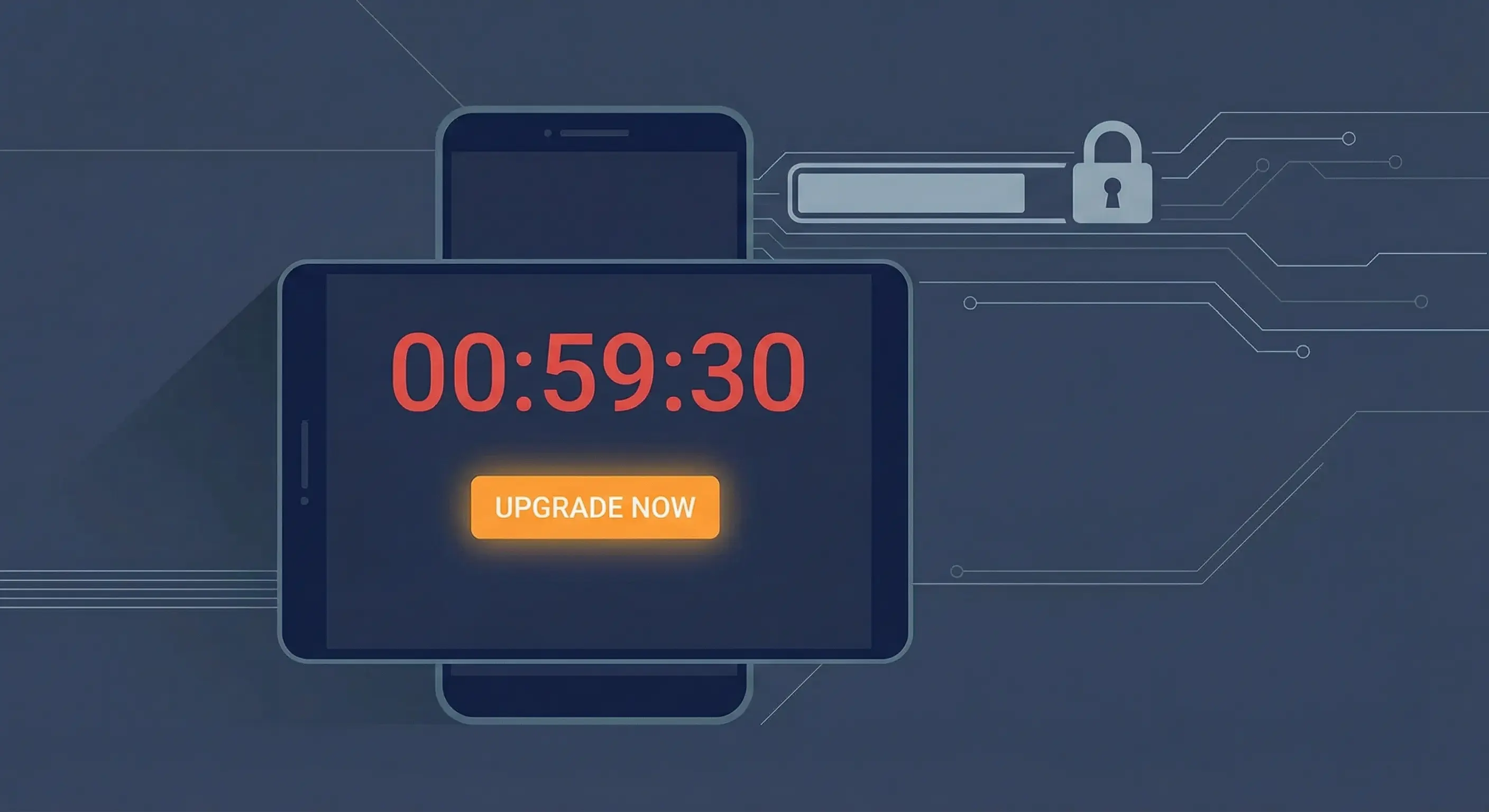
A countdown timer attached to a subscription offer implies the deal expires. In practice, many of them reset as soon as they hit zero, or the offer stays live regardless of whether the timer ran out.
A 2022 research study presented at the FTC's PrivacyCon conference found 157 instances of deceptive countdown timers across 140 sites. A timer was classified as deceptive if it reset after expiring with the same offer still available, or if the offer remained live after the "deadline." Both are common.
Duolingo and similar apps commonly run time-limited discount offers on subscription upgrades within the app, a pattern catalogued by deceptive.design and frequently reported by users in community forums. The mechanic triggers loss aversion: a discounted price feels like something you can lose, even if the loss is manufactured. According to Kahneman and Tversky's prospect theory, people weight potential losses more heavily than equivalent gains. That asymmetry is what these timers exploit.
The same approach appears across hundreds of apps in the productivity and language-learning categories. A "deal ending in 12 hours" primes you to act on that loss, even when "acting" means paying for something you were managing fine without.
If you see a countdown timer on an upgrade prompt: open the app in a different browser or after the timer expires. Most "deals" persist indefinitely.
Artificial limits designed to frustrate free users into paying
The free tier in most apps isn't designed to be useful. It's designed to be almost useful.
Candy Crush gives you five lives. Use them, and you wait up to 30 minutes for each to refill, or you pay for more. This functions less as a resource management mechanic and more as a deliberate friction point. Brignull's deceptive.design catalog documents this as a hard wall timed to coincide with the peak of a play session, when frustration converts best.
Storage limits on cloud services follow the same logic. The free tier is calibrated at a point just below where most active users will naturally land. You get comfortable using the service. You store things. Then you hit the wall. At that point, switching costs (re-downloading, finding alternatives, losing access) often exceed the subscription cost. Paying feels easier than leaving. That's the calculation.
Some limits are genuinely about infrastructure costs. Others are artificial ceilings set to trigger upgrade conversion at the right psychological moment. The difference is rarely disclosed.
The tell is when the limit feels designed to catch you mid-task. A 5-file export cap. A 10-minute recording limit. A three-project maximum on a project management tool. These aren't resource constraints. They're friction thresholds.
Feature removal after free trial: the bait-and-switch flow
A free trial and a free tier are different things. A lot of apps blur this on purpose.
A free trial gives you full access for a defined period and then removes it. A free tier gives you a permanent subset of features with the option to upgrade. The confusion between these two creates a specific dark pattern. Apps present a free trial as if it were a free tier, let you build habits around premium features, and then remove those features when the trial ends.
The removal is timed. Users who have invested time customizing, creating, or integrating a tool feel the loss of that investment when features disappear. That investment, including data, settings, and muscle memory, becomes something companies can use against you.
The most cynical version of this pattern involves onboarding flows that deliberately guide free trial users toward premium features, never mentioning that those features require payment after the trial period. You build your workflow on a feature that was never actually free. Then the trial ends and your workflow breaks.
A legitimate freemium model tells you clearly and upfront which features are free and which require payment. The bait-and-switch model tells you after you're invested.
Subscription enrollment dark patterns: you signed up, right?
Auto-renewal opt-outs buried in fine print. Pre-checked boxes you scroll past. Virtual currencies that obscure what you're actually spending.
The FTC and international consumer protection networks analyzed 642 websites and apps offering subscription services in 2024. They found that 81% used "sneaking": defined as the inability to turn off auto-renewal during signup. In 67% of cases, the providers failed to make pricing and terms easy to find.
Amazon's Prime enrollment case is the clearest example of what this looks like at scale. The FTC sued Amazon in June 2023, alleging the company used "manipulative, coercive, or deceptive user-interface designs" to enroll users in Prime without their informed consent. The complaint described checkout flows that routed users into Prime enrollment as a default step, with opt-out buried or absent.
Epic Games ran a similar pattern in Fortnite. The FTC's final order described design tricks that caused players to make unintentional in-game purchases. A significant mechanism was the intermediate currency: V-Bucks, which players purchase in round numbers that don't match item costs. You buy 1,000 V-Bucks for $7.99. An item costs 800. You spend the 1,000 and have 200 left. To use the leftover, you buy another 1,000. The virtual layer makes it harder to track real spending.
Epic paid $245 million. That was the largest FTC administrative settlement at the time.
Cancellation obstruction: what the roach motel looks like
You can check in, but checking out takes six screens, a retention offer, a pause option you didn't ask for, and a confirmation email that may or may not actually cancel anything.
That's the roach motel. The term comes from the ad slogan ("You can check in, but you can't check out"), and it describes subscription flows designed to wear users down before they can leave. A 2024 paper from the ACM CHI Conference studied cross-country subscription and cancellation flows and documented the pattern across major news platforms.
Amazon's cancellation flow had so many steps that internal documentation reportedly called it the "Iliad" flow (a reference to the epic poem's length). The FTC complaint described it as a multi-screen process designed to sabotage cancellation attempts. Amazon settled and agreed to pay $1.5 billion in refunds to affected customers.
Adobe's situation was about hidden costs, not just steps. When users tried to cancel their "annual paid monthly" Creative Cloud subscriptions, many discovered for the first time that Adobe charged an Early Termination Fee (ETF) equal to 50% of remaining payments. The FTC complaint described the ETF as hidden during signup. The ETF appeared in a small info icon that, when clicked, didn't reveal the actual dollar amount. The cancellation flow itself involved multiple unnecessary steps.
Common cancellation obstruction tactics in the wild:
- Offering a "pause" or "discount" before showing the cancel option
- Adding a confirmation step that says cancellation is "pending" and requires a follow-up
- Routing mobile users to a website to cancel when they signed up in-app
- Making the cancellation button visually identical to the "keep my plan" button
- Sending a retention email after cancellation that implies the process didn't complete
How the FTC is fighting back against dark patterns
The FTC has been aggressive on dark patterns, with mixed results.
The agency's "Click to Cancel" rule, finalized in October 2024, required that all subscription services offer a cancellation mechanism at least as simple as the signup method. If you could sign up in one click, you had to be able to cancel in one click. If you signed up online, cancellation had to be available online.
The 8th Circuit Court of Appeals vacated the rule in July 2025, citing procedural flaws in how it was adopted. The FTC may reissue it. But even without a federal rule, the agency's position is that complex cancellation flows can violate existing law under ROSCA (the Restore Online Shoppers' Confidence Act) and Section 5 of the FTC Act.
The enforcement record shows the agency will litigate:
- Amazon: $1.5 billion settlement for Prime enrollment and cancellation practices
- Epic Games: $245 million for dark patterns in Fortnite purchases
- Adobe: Federal complaint filed June 2024 for hidden ETF and cancellation obstruction
These aren't small companies with weak legal teams. They built dark patterns into their products, calculated that revenue outweighed risk, and in two of those three cases the FTC disagreed.
What good app monetization actually looks like
Dark patterns maximize short-term conversion by extracting money from users who didn't really choose to spend it. Users who convert through manipulation tend to churn faster, leave negative reviews, and cost more in refund requests.
Honest monetization looks like:
- A free tier with permanently available features and clear upgrade value
- Annual pricing shown upfront at signup, with no buried ETF
- Cancellation on the same screen where you manage your subscription
- Upgrade prompts that appear once and stay gone when dismissed
Apps that do this exist. The ones that don't have often made a deliberate choice about how they want to grow. And who they're willing to manipulate to get there.
Key terms
Dark pattern is a user interface design category that encompasses choices deliberately crafted to manipulate users into taking actions against their interests, typically to benefit the company at the user's expense.
Roach motel is a subscription design pattern where signing up is easy and cancellation is deliberately difficult. Named after the pest control slogan.
Sneaking is a dark pattern category in which companies auto-enroll users in recurring charges or hide material terms during signup.
Negative option marketing is a sales model where continued inaction (not canceling) is treated as ongoing consent to be charged. The FTC's ROSCA governs this.
Early Termination Fee (ETF) is a charge applied when canceling a subscription before a commitment period ends, used as a dark pattern when hidden at signup.
ROSCA is the Restore Online Shoppers' Confidence Act, federal law the FTC uses to prosecute subscription dark patterns.
FAQ
What is a dark pattern in app monetization?
A dark pattern in app monetization is a deliberate design choice that manipulates users into spending money they didn't intend to spend, or keeps them paying for subscriptions they want to cancel. The FTC's 2022 report identifies four main categories: sneaking (hiding terms), urgency (fake countdown timers), obstruction (complex cancellation), and nagging (repeated upsell prompts). These are not UX mistakes. They are tested and optimized for conversion. The term was coined by researcher Harry Brignull in 2010 and is now standard terminology in both UX and consumer protection law.
Are app monetization dark patterns illegal in the United States?
Some are. The FTC can prosecute app monetization dark patterns under ROSCA (the Restore Online Shoppers' Confidence Act) and Section 5 of the FTC Act, which prohibits unfair or deceptive business practices. Amazon paid $1.5 billion in settlement over Prime enrollment and cancellation patterns. Epic Games paid $245 million for dark patterns in Fortnite. Adobe faces a federal complaint over hidden fees and cancellation obstruction. Whether any specific dark pattern is illegal depends on how deceptive it is and whether it involves a subscription service.
How do I cancel a subscription when an app's dark pattern blocks cancellation?
If an app's cancellation flow won't work, your next options are: (1) Cancel through your device's subscription manager. On iOS, go to Settings > your name > Subscriptions. On Android, open Google Play > Subscriptions. This bypasses the app entirely. (2) Contact your bank or credit card to dispute future charges or issue a stop-payment on the merchant. (3) File a complaint with the FTC at ReportFraud.ftc.gov. Reports go into a database used to build enforcement cases. If you signed up online and the only cancellation option is a phone call, that may violate ROSCA, which requires cancellation through the same channel as signup.
How did the FTC 'Click to Cancel' rule aim to stop app monetization dark patterns?
The FTC finalized its "Click to Cancel" rule in October 2024. It required all companies using negative option marketing (subscriptions that auto-renew) to offer a cancellation mechanism as simple as their signup process. If you signed up online, cancellation had to be available online. The 8th Circuit Court of Appeals vacated the rule in July 2025, citing procedural issues with how it was adopted. As of early 2026, the rule is not in force, but the FTC has stated that complex cancellation flows can still violate existing law under ROSCA and Section 5 of the FTC Act. The agency may reissue a revised version of the rule.
How can I tell if a countdown timer is a fake app monetization dark pattern?
The simplest test: let the timer expire and see if the offer changes. If the timer hits zero and the same offer is still available, or resets, it was fake. A 2022 academic study submitted to the FTC's PrivacyCon found 157 deceptive countdown timers across 140 websites. The majority reset after expiring with the same deal still available. Another approach: close the app and reopen it. Many countdown timers reset on app relaunch, which reveals that the "deadline" is per-session theater, not a real offer window.
Related resources
- AI Tools I Actually Pay For (And Which Ones I Canceled): hands-on look at subscription tools worth the cost
- The Writing Stack I Use After Testing 15+ Tools: how to evaluate SaaS tools before committing money
- A Junior Dev Got Fired for AI Code. His Manager Used AI to Review It.: on tech companies and accountability gaps
Changelog
| Date | Change |
|---|---|
| 2026-03-23 | Initial draft |
| 2026-03-25 | Phase 8-11 editorial pass: fixed double periods, image path (webp), AI vocabulary, bold overuse, internal links, key terms format |
| 2026-03-25 | QC fix pass: title length, summary keyword placement, HR removal, FAQ topic names, inline citations, non-official sources replaced, long sentences split, significance inflation softened, absolutes softened |
Fixes when it breaks. Workflows when it doesn't.
OpenClaw guides, configs, and troubleshooting notes. Every two weeks.