Gemini 3.1 Pro Coding Benchmarks: Developer Results
Gemini 3.1 Pro scores 2887 Elo on LiveCodeBench and 80.6% on SWE-Bench at $2/$12 per million tokens. Where it leads and where it falls short.
Key takeaways
Every few months, a new model claims the coding crown. Most of the time, the numbers are cherry-picked and the real-world difference is marginal. Gemini 3.1 Pro, released February 19, 2026, is more interesting than that. It tops 12 of 18 tracked coding benchmarks at $2/$12 per million tokens, which is 7.5x cheaper than Claude Opus 4.6 on input. But here's the catch: developers on LM Arena still prefer Opus for actual coding work. Benchmarks and preference are telling different stories right now, and that gap is worth understanding before you switch anything.
Fixes when it breaks. Workflows when it doesn't.
OpenClaw guides, configs, and troubleshooting notes. Every two weeks.
Key takeaways
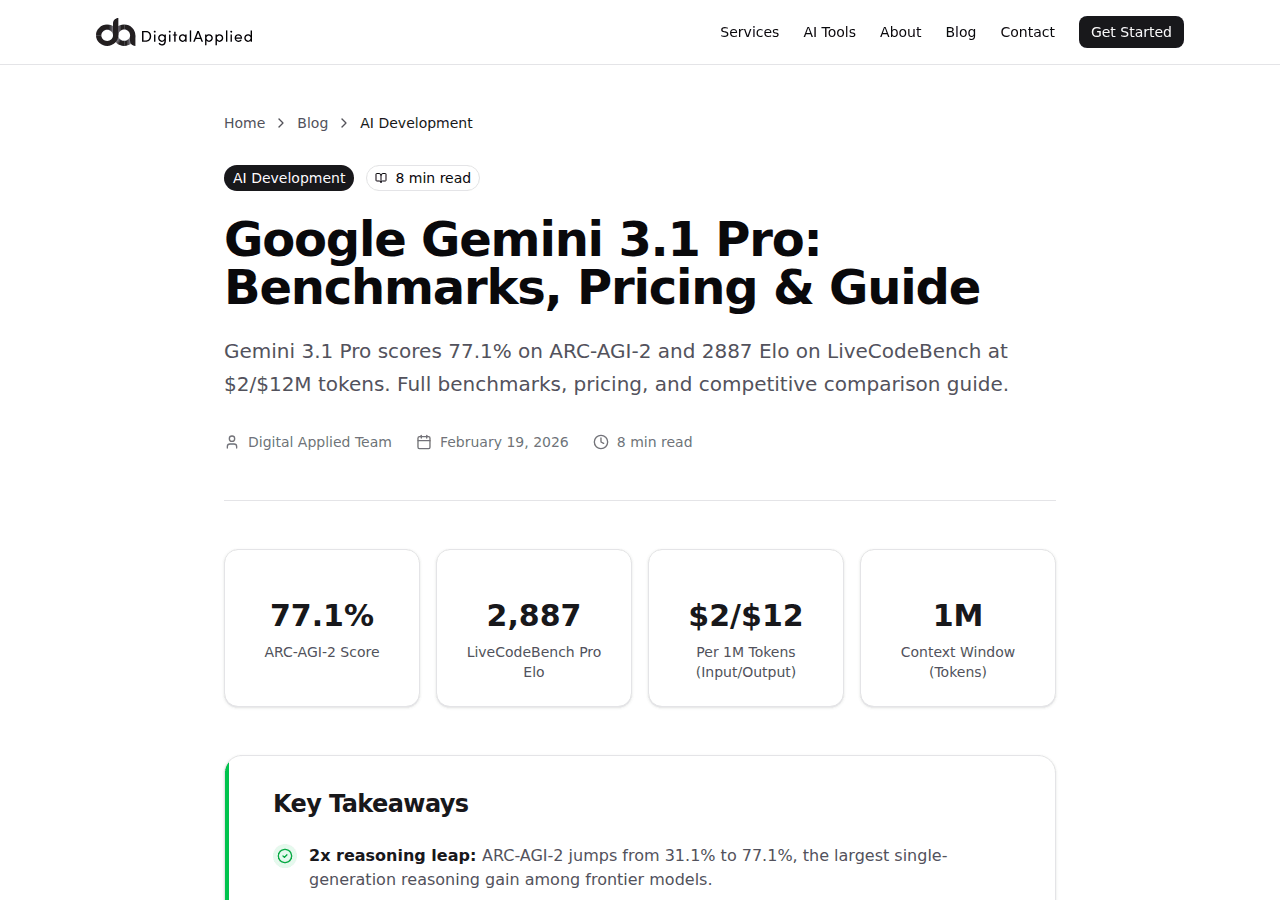
Gemini 3.1 Pro is Google's strongest coding model. It scores 2887 Elo on LiveCodeBench Pro, 80.6% on SWE-Bench Verified, and 77.1% on ARC-AGI-2. Pricing stays at $2 input / $12 output per million tokens. All benchmark data comes from Google's announcement and Digital Applied's compilation.
It's not the best everywhere. Claude Opus 4.6 edges it on SWE-Bench Verified (80.8%) and GPT-5.3-Codex leads on Terminal-Bench 2.0 (77.3% vs 68.5%). No single model wins every benchmark. But for general-purpose coding at this price, Gemini 3.1 Pro is the current leader.
| Benchmark | Gemini 3.1 Pro | Claude Opus 4.6 | GPT-5.2 | GPT-5.3-Codex |
|---|---|---|---|---|
| LiveCodeBench Pro (Elo) | 2887 | N/A | 2393 | N/A |
| SWE-Bench Verified | 80.6% | 80.8% | 80.0% | N/A |
| Terminal-Bench 2.0 | 68.5% | 65.4% | 54.0% | 77.3% |
| SWE-Bench Pro | 54.2% | N/A | N/A | 56.8% |
| ARC-AGI-2 | 77.1% | 68.8% | 52.9% | N/A |
Available now in GitHub Copilot, Google AI Studio, Gemini API, Vertex AI, and Android Studio.
What Changed in Gemini 3.1 Pro
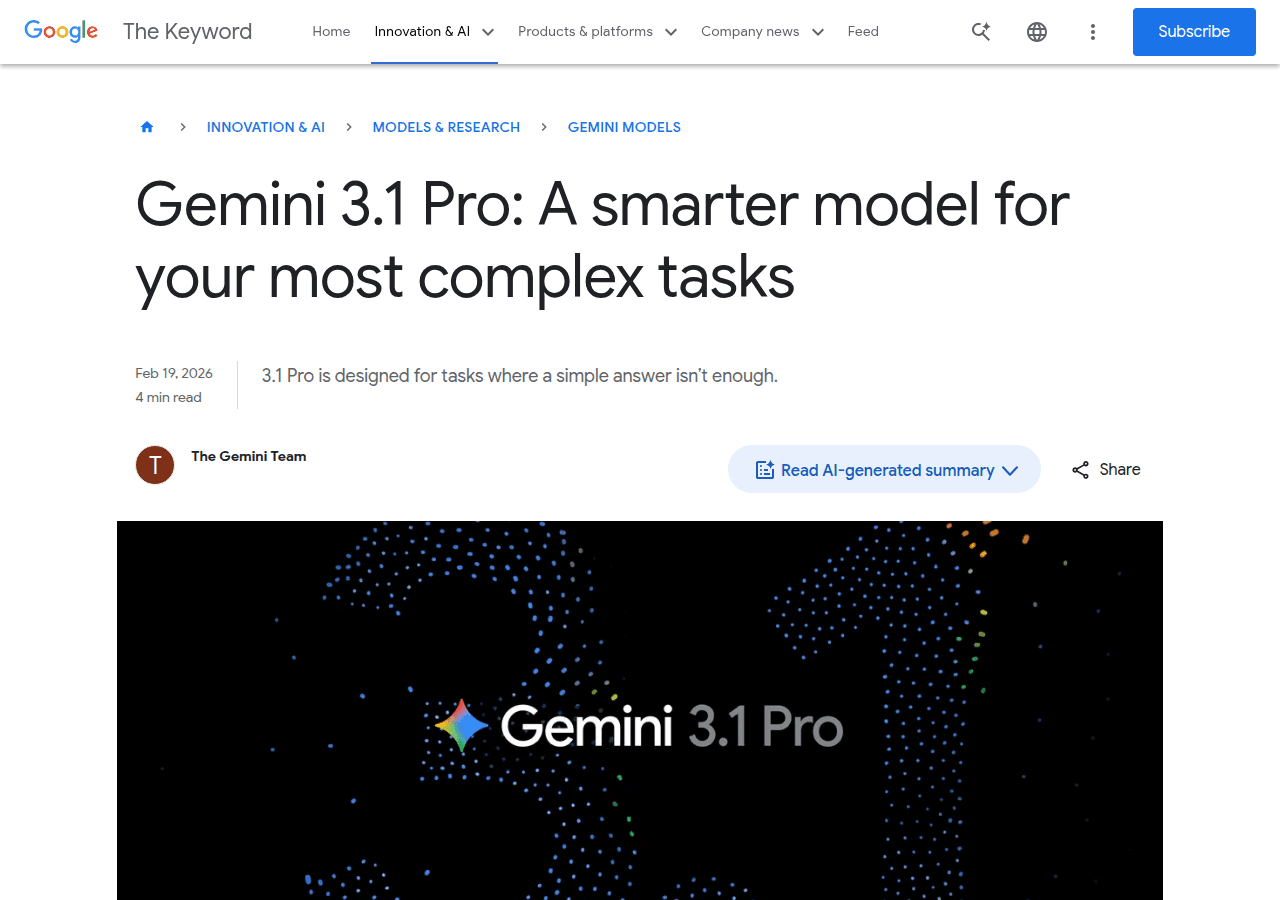
Google released Gemini 3.1 Pro on February 19, 2026 as a preview across their developer and consumer products. This is the first ".1" increment between major Gemini versions. Previous versions used ".5" for mid-cycle updates, so the naming change signals a tighter improvement cycle.
Reasoning depth is the core improvement. On ARC-AGI-2, a benchmark that tests novel problem-solving without memorized patterns, Gemini 3.1 Pro scores 77.1%. That's more than double Gemini 3 Pro's 31.1%. Google says the model extracts more insight per compute token during reasoning.
Key changes from Gemini 3 Pro:
- ARC-AGI-2: 77.1%, up from 31.1% (a 46 percentage point jump)
- LiveCodeBench Pro: 2887 Elo, up from 2439 (18% improvement)
- New Medium thinking level: Balance cost and reasoning depth per request
- Same pricing: $2 input / $12 output per million tokens, unchanged from 3 Pro
- 1M token context window with up to 75% savings through context caching
The model is available through Google AI Studio, the Gemini API, Vertex AI, Gemini CLI, Google Antigravity, and Android Studio. Consumer access is rolling out through the Gemini app and NotebookLM for Pro and Ultra plan users.
Coding Benchmark Breakdown
The TLDR table above gives you the headline numbers. This section breaks down what those benchmarks actually test and where the margins are thin enough to ignore.
Competitive Coding
LiveCodeBench Pro measures performance on competitive programming problems. Gemini 3.1 Pro hits 2887 Elo, which is 21% above GPT-5.2 at 2393 Elo and 18% above Gemini 3 Pro at 2439 Elo. This is the clearest lead in the coding category.
Real-World Software Engineering
SWE-Bench Verified tests models on real GitHub issues. Gemini 3.1 Pro scores 80.6%. Claude Opus 4.6 scores 80.8%. The difference is 0.2 percentage points, which is within noise. For practical purposes, they're tied on this benchmark.
On SWE-Bench Pro (public), Gemini 3.1 Pro scores 54.2%. GPT-5.3-Codex leads at 56.8%.
Terminal and System Tasks
Terminal-Bench 2.0 tests system-level tasks. GPT-5.3-Codex dominates at 77.3%. Gemini 3.1 Pro comes in at 68.5%, and Claude Opus 4.6 at 65.4%. This is one benchmark where Codex has a clear, meaningful lead.
Scientific Coding
SciCode measures performance on scientific programming tasks. Gemini 3.1 Pro scores 59%, ahead of both Claude Opus 4.6 (52%) and GPT-5.2 (52%).
Agentic Tool Use
MCP Atlas tests multi-tool coordination, which matters for agents that call multiple APIs. Gemini 3.1 Pro leads at 69.2%, ahead of Claude Sonnet 4.6 (61.3%) and Opus 4.6 (59.5%).
Community Testing (and Why It Tells a Different Story)
This is the section that complicates the narrative. LM Arena, where developers compare models in blind tests, puts Gemini 3.1 Pro at 1461 Elo for code. Claude Opus 4.6 with thinking scores 1560. That's a 99-point gap in Opus's favor, on a platform where users are judging real coding output, not synthetic puzzles.
Developers in the r/singularity discussion back this up. Codex 5.3 and Opus 4.6 remain the go-to models for people doing real work, even as Gemini tops the benchmark charts.
Why the disconnect? LiveCodeBench tests competitive programming. LM Arena tests what developers actually prefer when they're writing production code. Solving algorithmic puzzles quickly and writing code that humans find useful are related skills, but they're not the same skill. Keep that in mind when reading the numbers above.
Where Gemini 3.1 Pro Wins
The benchmark breakdown above covers the coding numbers. But Gemini 3.1 Pro's lead extends beyond code. Across 18 tracked benchmarks, it holds the top spot on at least 12. The non-coding wins that matter most:
Graduate-level science. GPQA Diamond at 94.3%, ahead of Opus 4.6 (91.3%) and GPT-5.2 (92.4%). If you're working on scientific or research-adjacent code, this performance carries over.
Tool coordination. MCP Atlas at 69.2%, the highest of any model tested. This is the benchmark that matters for anyone building agents that chain API calls. Opus 4.6 scores 59.5% here, which is a meaningful gap.
Web research. BrowseComp at 85.9%, ahead of Opus 4.6 (84.0%). Smaller margin, but consistent.
The throughline: Gemini 3.1 Pro does well on tasks that require coordination and reasoning across multiple steps. The $2/$12 pricing makes it 7.5x cheaper than Opus on input, which compounds fast in agentic workflows where you're passing large context windows repeatedly.
Where Competitors Still Lead
Three areas where switching to Gemini would cost you performance.
Specialized coding workflows. GPT-5.3-Codex leads on Terminal-Bench 2.0 (77.3% vs 68.5%) and SWE-Bench Pro (56.8% vs 54.2%). If your work is terminal-heavy or focused on resolving complex GitHub issues, Codex is still the specialist.
Expert office tasks. Claude Sonnet 4.6 and Opus 4.6 dominate GDPval-AA at 1633 and 1606 Elo respectively. Gemini 3.1 Pro scores 1317. That's a large gap on tasks that simulate expert-level office work.
Developer preference. On LM Arena, where developers vote on which model they prefer, Opus 4.6 with thinking (1560 Elo) outranks Gemini 3.1 Pro (1461 Elo) for code. Benchmark leaderboards and real-world preference don't always align.
| Area | Leader | Score | Gemini 3.1 Pro |
|---|---|---|---|
| Terminal-Bench 2.0 | GPT-5.3-Codex | 77.3% | 68.5% |
| SWE-Bench Pro | GPT-5.3-Codex | 56.8% | 54.2% |
| GDPval-AA | Claude Sonnet 4.6 | 1633 Elo | 1317 Elo |
| SWE-Bench Verified | Claude Opus 4.6 | 80.8% | 80.6% |
| LM Arena Code | Opus 4.6 Thinking | 1560 Elo | 1461 Elo |
The pattern: Gemini 3.1 Pro is the generalist. Specialists still win in their lanes.
GitHub Copilot Integration
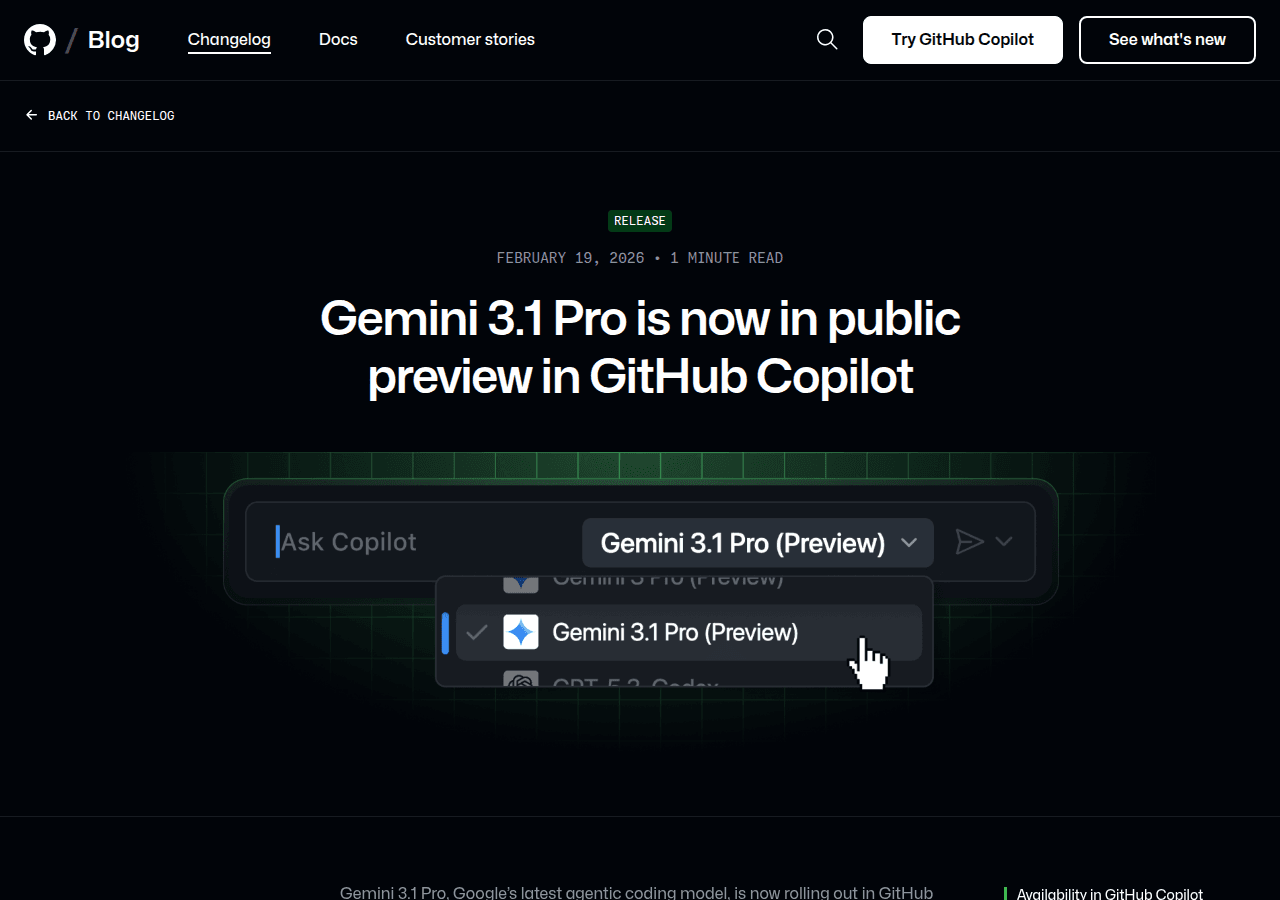
Gemini 3.1 Pro rolled out in GitHub Copilot on February 19, 2026 as a public preview. This is the most direct way for developers to try it without touching an API.
Who gets access:
- Copilot Pro, Pro+, Business, and Enterprise users
Where it works:
- VS Code: chat, ask, edit, and agent modes
- Visual Studio: agent and ask modes
- github.com
- GitHub Mobile (iOS and Android)
GitHub reports that early testing shows "high tool precision" with "strong resolution success with fewer tool calls per benchmark." Translation: the model gets things right with less back-and-forth, which means faster completions and lower token usage.
Rollout is gradual. If you don't see it in your model picker yet, check back. Business and Enterprise administrators need to enable the Gemini 3.1 Pro policy in Copilot settings.
Pricing and Access
The pricing tells a clear story.
| Model | Input (per 1M tokens) | Output (per 1M tokens) | Context Window |
|---|---|---|---|
| Gemini 3.1 Pro | $2.00 | $12.00 | 1M tokens |
| Gemini 3.1 Pro (>200K context) | $4.00 | $18.00 | 1M tokens |
| Claude Sonnet 4.6 | $3.00 | $15.00 | 1M tokens |
| Claude Opus 4.6 | $15.00 | $75.00 | 1M tokens |
| GPT-5.2 | $2.50 | $10.00 | 1M tokens |
On price, it's 7.5x cheaper than Opus 4.6 on input and 6.25x cheaper on output. Against GPT-5.2, it's 20% cheaper on input and 20% more expensive on output.
Context caching can reduce costs by up to 75% for workloads that reuse large prompts. This helps for agentic workflows that pass the same codebase context repeatedly.
Where to access Gemini 3.1 Pro:
- Google AI Studio (free tier with rate limits)
- Gemini API (production access)
- Vertex AI (enterprise, GCP infrastructure)
- GitHub Copilot (Pro/Business/Enterprise plans)
- Gemini CLI (terminal workflows)
- Google Antigravity (agentic IDE)
- Android Studio (mobile development)
When to Use Gemini 3.1 Pro (and When Not To)
The honest answer: if you're choosing a single model for general coding work and cost matters, Gemini 3.1 Pro is the obvious one to evaluate first. It wins on price and wins on most benchmarks. That's a straightforward call.
It gets more nuanced if you have specific needs. Terminal-heavy workflows (system admin, shell scripting, infrastructure automation) still favor GPT-5.3-Codex, which leads Terminal-Bench by nearly 9 points. If you're building agentic systems that chain tools together, Gemini's MCP Atlas lead is meaningful. And if you've been using Claude Opus 4.6 and it's working well for you, the LM Arena preference data suggests there's something Opus does in practice that benchmarks don't fully capture. Switching away from a model you trust based on benchmark tables alone isn't always smart.
The Medium thinking level is the feature to watch. Low for autocomplete, Medium for code review and multi-step tasks, High for complex debugging. Being able to tune reasoning cost per request is something Claude and GPT don't currently offer, and it changes the economics of running models at scale.
FAQ
Is Gemini 3.1 Pro better than Claude for coding?
It depends on the task. Gemini 3.1 Pro leads on LiveCodeBench (2887 Elo), ARC-AGI-2 (77.1% vs 68.8%), and MCP Atlas (69.2% vs 59.5%). Claude Opus 4.6 leads on SWE-Bench Verified (80.8% vs 80.6%) and LM Arena code preference (1560 vs 1461 Elo). For general coding, Gemini 3.1 Pro wins on benchmarks. For real-world developer preference, Claude still has an edge.
Can I use Gemini 3.1 Pro in GitHub Copilot?
Yes. It rolled out February 19, 2026 in public preview for Copilot Pro, Pro+, Business, and Enterprise users. Select it in the model picker in VS Code, Visual Studio, github.com, or GitHub Mobile. Enterprise admins need to enable the policy first.
How does it compare to GPT-5.2 on price?
Pricing: $2 input / $12 output per million tokens. GPT-5.2 runs $2.50 input / $10 output. Gemini is cheaper on input, slightly more expensive on output. For input-heavy workloads (large codebases, long prompts), Gemini saves money. For output-heavy workloads (code generation), GPT-5.2 is slightly cheaper.
What is the context window?
1 million tokens with a 64K token output limit. Context over 200K tokens costs $4/$18 per million tokens instead of $2/$12.
Is this a full release or a preview?
Preview. Google released Gemini 3.1 Pro in preview on February 19, 2026 to validate updates before general availability. GA is expected soon but no date has been announced.
Key Terms
LiveCodeBench Pro: A benchmark measuring AI model performance on competitive programming problems, scored using Elo ratings.
SWE-Bench Verified: A benchmark testing AI models on real GitHub issues, measuring their ability to resolve actual software bugs and feature requests.
ARC-AGI-2: A reasoning benchmark that tests novel problem-solving without relying on memorized patterns.
MCP Atlas: A benchmark measuring how well models coordinate across multiple tools and APIs.
GDPval-AA: A benchmark evaluating AI performance on expert-level office and professional tasks.
LM Arena: A community platform where users compare AI models in blind tests, generating Elo ratings based on preference.
Sources
- Gemini 3.1 Pro: A smarter model for your most complex tasks (Google Blog, February 19, 2026)
- Google Gemini 3.1 Pro: Benchmarks, Pricing & Guide (Digital Applied, February 19, 2026)
- Gemini 3.1 Pro is now in public preview in GitHub Copilot (GitHub Changelog, February 19, 2026)
- Gemini 3.1 Pro (Google DeepMind model page)
- Reddit r/singularity: Google releases Gemini 3.1 Pro with Benchmarks (Reddit, February 19, 2026)
Conclusion
On paper, Gemini 3.1 Pro is the best deal in AI coding right now. It tops most benchmarks at a fraction of Opus pricing, and the MCP Atlas scores suggest it's particularly strong for the agentic, tool-chaining workflows that are becoming standard.
But "on paper" is doing work in that sentence. The LM Arena preference gap is real, and the developers who use these models daily haven't crowned Gemini yet. Whether that's inertia, something Opus does that benchmarks miss, or just not enough time with the new model, it's worth watching.
If you're cost-sensitive and building general-purpose coding workflows, try it. If you're happy with your current model and it's working, the benchmarks alone aren't a reason to switch. Access it through GitHub Copilot, Google AI Studio, or the Gemini API.
If you're evaluating AI coding assistants more broadly, see our comparison of the best AI code assistants for 2026. For running AI agents on budget infrastructure, check our OpenClaw on DigitalOcean guide.
Changelog
- 2026-02-24: Initial publication with benchmark data from Gemini 3.1 Pro preview release.
Fixes when it breaks. Workflows when it doesn't.
OpenClaw guides, configs, and troubleshooting notes. Every two weeks.