How TwainGPT Humanizer Actually Works: Unicode Analysis
How TwainGPT humanizer works, whether it uses unicode substitution, and what the evidence actually shows about bypassing AI detectors.
Key takeaways
- TwainGPT describes its method as NLP-based rewriting. It has never confirmed using unicode substitution or homoglyph tricks in any published documentation.
- Homoglyph attacks are real and documented: a 2025 COLING workshop paper found they dropped detector accuracy from MCC 0.64 to -0.01 across seven detectors.
- Test results for TwainGPT vary sharply. One user reported 0% AI detection on ZeroGPT. Another reported 100% on GPTZero. Both results are plausible and not contradictory.
- Advanced detectors can flag text with hidden unicode anomalies as suspicious, which limits the long-term viability of unicode-based evasion.
- If you're evaluating TwainGPT, test it on your specific content and your target detector. Aggregate claims of "100% bypass" don't hold across use cases.
Fixes when it breaks. Workflows when it doesn't.
OpenClaw guides, configs, and troubleshooting notes. Every two weeks.
What TwainGPT claims its humanizer does
TwainGPT's own blog describes a process of deep content analysis followed by NLP-based rewriting. The stated goal is removal of AI patterns through what they call "rhythmic consistency adjustment" and changes to sentence structure, vocabulary, and tone. They target GPTZero, ZeroGPT, Turnitin, Copyleaks, QuillBot, and Grammarly by name.
What they don't disclose: the underlying model architecture, whether they use a fine-tuned LLM or a rule-based system, and just what "micro-level stylistic markers" refers to in technical terms. The phrase appears in their marketing copy but without a definition. Whether that's intentional obfuscation or just marketing imprecision isn't clear from publicly available information.
They claim 2.1 million users as of November 2025 (up from 400k earlier that year per their earlier posts). That's self-reported and unverified.
What unicode substitution actually is in AI detection bypass
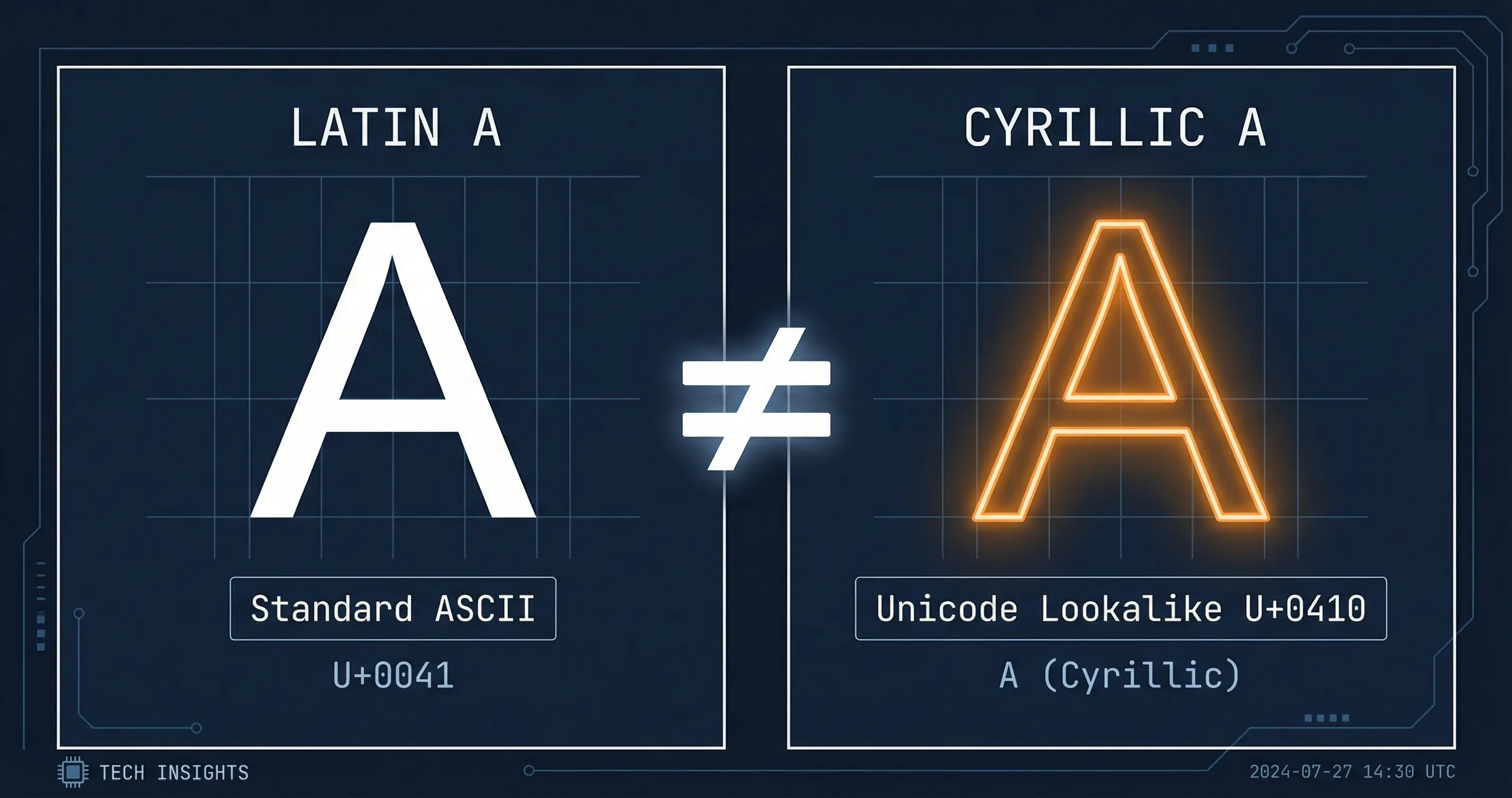
Unicode substitution in this context means replacing standard characters with visually identical ones from different Unicode code points. The classic example is swapping a Latin "A" (U+0041) for a Cyrillic "А" (U+0410). They look identical on screen. Computers treat them as completely different.
There are two main variants:
Homoglyph substitution: Replacing letters with look-alikes from other scripts. A sentence like "That idea works" reads normally to a human but contains non-Latin characters that break up the statistical fingerprints AI detectors look for.
Zero-width characters: Invisible characters like the zero-width space (U+200B) and zero-width joiner (U+200D) can be inserted between or within words. They're invisible but processed by computers. According to JustDone.com's analysis, some LLMs inadvertently insert these as copy/paste artifacts, which is one reason you sometimes see unusual detector behavior even without intentional manipulation.
The mechanism at the detection level: most AI detectors measure perplexity (how predictable the text is given a language model) and burstiness (how much perplexity varies sentence to sentence). Homoglyphs disrupt tokenization. A detector's tokenizer breaks "А" into different tokens than "A," changing the perplexity calculation in unpredictable ways.
How homoglyph attacks affect AI detector accuracy
The most rigorous published evidence comes from a COLING 2025 workshop paper that tested homoglyph attacks across seven AI detectors and five datasets. The results were striking: average Matthews Correlation Coefficient (MCC) dropped from 0.64 to -0.01. An MCC of -0.01 is essentially random performance. The detectors went from functioning to useless.
The effect wasn't uniform across detector types. Perplexity-based detectors (which analyze statistical patterns in raw tokens) were more vulnerable. Classification-based detectors (which use a trained model to recognize AI patterns) showed more resilience, though still degraded.
One important constraint: the paper tested substitution applied systematically. Partial or inconsistent substitution produces less dramatic results. And the detection arms race has moved since that paper -- more on that below.
Does TwainGPT actually use unicode or homoglyph tricks?
No public documentation from TwainGPT confirms this. I reviewed their main blog post and available product documentation. No mention of unicode, homoglyphs, invisible characters, or code point manipulation. Their described method is NLP rewriting.
That said, absence of documentation isn't proof of absence. A company could implement unicode tricks without disclosing it. A few observations:
If TwainGPT used systematic homoglyph substitution, you'd expect to see consistent results across similar inputs, because the substitution mechanism itself is deterministic. Instead, user reports show high variance (see the test results section below), which is more consistent with NLP rewriting that depends heavily on input quality than with a mechanical substitution layer.
You'd also expect technically-minded users to have caught this by now. Examining a text file's bytes or running it through a Unicode inspector takes seconds. If TwainGPT were injecting homoglyphs, someone would have documented it with hex dumps by now. That documentation doesn't appear to exist in the public record.
The honest answer: TwainGPT's actual mechanism is not publicly disclosed in technical detail. The evidence leans toward NLP rewriting, not unicode substitution. But it hasn't been independently audited.
How NLP-based AI humanization works
NLP-based humanization targets the signals AI detectors actually measure. GPTZero's own documentation describes their use of perplexity and burstiness. A typical AI-generated paragraph has low perplexity (predictable word choices) and low burstiness (uniform sentence lengths). Human writing varies more.
An NLP humanizer rewrites text to increase these variance signals:
- Adding contractions ("do not" becomes "don't")
- Varying sentence lengths (mix short sentences with longer ones)
- Changing vocabulary to less statistically predictable choices
- Adjusting paragraph rhythm so not every paragraph is the same length
This is why humanizer output can look stylistically odd. The rewriter isn't trying to sound good. It's trying to score well on perplexity metrics.
The limitation is obvious: this works until detectors adapt their models to recognize humanized-AI text as a distinct pattern. If you train a detector on enough TwainGPT outputs, you can build a classifier that identifies TwainGPT-style rewriting by pattern. That's the arms race.
TwainGPT GPTZero test results: what users actually report
User testing results are split. On r/humanizing, one user tested TwainGPT across multiple detectors and found GPTZero flagged the output at 100% AI while ZeroGPT showed 0% detection on the same text. That's not a contradiction. It reflects detector disagreement, not tool failure.
A separate post on r/bestaihumanizers reports 0-1% AI detection across multiple detectors after TwainGPT processing. No input text shown, no methodology disclosed. These are anecdotal, but first-hand.
What neither test discloses: the input text. TwainGPT's output quality varies with input complexity. A simple paragraph about a generic topic will humanize differently than a technical analysis with specific claims. Reviews that don't show the input aren't useful for calibration.
TwainGPT ZeroGPT and Turnitin pass rates
ZeroGPT pass rates from user reports are generally more positive than GPTZero results. That fits with what's known about these detectors: they use different models and different thresholds, and ZeroGPT has a reputation for higher false-negative rates (letting AI text through) compared to GPTZero.
On Turnitin: TwainGPT's marketing claims bypass capability, but there's no confirmed independent third-party test of Turnitin results with TwainGPT output in the public record. Turnitin's AI detection is separate from its plagiarism detection and uses a different model. Academic use of humanizers to defeat Turnitin is also a different category of concern than general content creation use, and comes with obvious ethical considerations that are outside the scope of this technical analysis.
Why AI detector results vary so much for the same text
The GPTZero-versus-ZeroGPT split above isn't unusual. Different detectors diverge frequently because they're not measuring the same thing. GPTZero uses a proprietary model trained on human versus AI text. ZeroGPT uses a different model. They have different training data, different architectures, and different threshold settings. A text that lands just below GPTZero's decision boundary might land well below ZeroGPT's.
This inconsistency is a property of the detector ecosystem, not a special property of TwainGPT. Any humanizer will produce this pattern. It means "bypass rate" as a single number is meaningless without specifying which detector, which version, and what input type.
One additional factor: JustDone.com notes that some detectors now flag unicode anomalies as suspicious rather than classifying them as human. So if a text contains zero-width characters or homoglyphs (whether intentionally or as LLM artifacts), it might score worse on some modern detectors than clean text would.
Can advanced AI detectors catch homoglyph substitution?
Yes, increasingly. The arXiv paper notes that Unicode NFKC normalization as a pre-processing step can standardize homoglyphs before analysis, largely neutralizing the attack. A detector that normalizes input first reduces the attack surface significantly.
Promptfoo's documentation on homoglyph strategy also confirms that some security-oriented detectors look for visual spoofing patterns as a detection signal. Text with unexpected unicode code points can be flagged as suspicious regardless of its other statistical properties.
The practical implication: homoglyph-based evasion worked well in the 2023-2024 period. The window is narrowing as detectors add unicode normalization and anomaly detection. NLP rewriting has a longer useful life because it targets structural properties of text rather than encoding tricks, even if those structural patterns are also increasingly catalogued.
Is TwainGPT worth using for AI detection bypass?
For casual content creation where you want to reduce AI detection signal on some detectors, TwainGPT can work. The NLP rewriting does change perplexity and burstiness scores, which affects results on simpler detectors.
For high-stakes use cases (academic submissions, enterprise content compliance, anything involving Turnitin), the available evidence doesn't support treating any humanizer as a reliable bypass. Detector inconsistency means you can't verify success without testing your exact content against your exact target.
For technical users curious about unicode bypasses: TwainGPT probably isn't doing that. The technique exists, it's been documented in peer-reviewed research, and it works against current-generation perplexity-based detectors. But it's not what TwainGPT appears to offer, and its effectiveness is declining as detectors add normalization steps.
Key terms
Homoglyph is a character that looks visually identical to another character but has a different Unicode code point. Swapping Latin "a" for Cyrillic "а" is a classic example used in detection bypass research and security testing.
Unicode substitution is the practice of replacing standard characters with visually identical alternatives from other Unicode blocks, used in AI detection evasion to disrupt tokenization-based analysis.
Perplexity is a measure of how predictable a sequence of text is given a language model. AI-generated text tends to have lower perplexity than human writing because the model selects high-probability word choices. GPTZero uses perplexity as a core detection signal.
Burstiness is the degree to which perplexity varies across sentences in a passage. Human writing shows more burstiness because humans mix simple and complex sentences unpredictably. AI writing tends to be more uniform.
NLP rewriting refers to using natural language processing techniques to rephrase text at the sentence and paragraph level, changing vocabulary, structure, and rhythm to alter statistical properties detectors rely on.
Matthews Correlation Coefficient (MCC) is a statistical measure of binary classification quality that accounts for class imbalance. An MCC of 1 is perfect, 0 is random, -1 is systematic inversion. The COLING 2025 homoglyph study found homoglyph attacks dropped average MCC from 0.64 to -0.01 across seven detectors.
FAQ
Does TwainGPT use unicode substitution to bypass AI detectors?
TwainGPT has not confirmed using unicode substitution, homoglyphs, or invisible characters in any published documentation. Their described method is NLP-based rewriting that adjusts sentence structure, vocabulary, and rhythm. No independent technical audit has documented homoglyph usage in TwainGPT's output. The available evidence suggests NLP rewriting rather than unicode tricks, but TwainGPT hasn't disclosed its technical implementation in detail, so the question can't be fully closed without independent analysis.
How does TwainGPT humanizer work technically?
TwainGPT describes using deep NLP analysis to identify and rewrite AI-generated patterns. According to their blog, this includes adjusting rhythmic consistency, varying vocabulary, and restructuring sentences to reduce the statistical uniformity that AI detectors target. The specific model architecture (whether fine-tuned LLM, rule-based rewriter, or hybrid) is not publicly disclosed. The output behavior, where results vary significantly with input complexity, is consistent with an LLM-based rewriting approach rather than a deterministic substitution method.
Can GPTZero detect TwainGPT humanized text?
User reports conflict. One documented test found GPTZero flagged TwainGPT output at 100% AI while ZeroGPT returned 0% on the same text. GPTZero uses a more sophisticated detection model than ZeroGPT and tends to produce more positive detections. Whether GPTZero catches TwainGPT output depends on the input text, content type, and GPTZero's current model version. Testing your specific content is the only reliable way to evaluate this.
Does TwainGPT pass Turnitin AI detection?
TwainGPT's marketing claims Turnitin bypass capability, but no confirmed independent third-party test results for Turnitin appear in the public record. Turnitin's AI detection runs separately from its plagiarism detection and uses a proprietary model. The ethical and policy implications of attempting to bypass Turnitin in academic contexts are a separate consideration entirely from the technical question.
What's the difference between TwainGPT and other AI humanizers?
TwainGPT is one of several NLP-based humanizers that target detector bypass. The main differentiators in this category are output quality (readability after rewriting), consistency across content types, and which detectors a tool was tuned against. TwainGPT claims to target six specific detectors. The inconsistency users report across detectors is typical of the category, not unique to TwainGPT. Without a controlled head-to-head comparison on the same inputs, attribution of performance differences to the tool itself versus input variation is unreliable.
Evidence & Methodology
Primary sources used in this article:
- TwainGPT official blog: https://www.twaingpt.com/blog/twaingpt/ (vendor, self-reported)
- "Evading AI-Generated Text Detectors using Homoglyphs", arXiv:2406.11239 (COLING 2025 workshop, peer-reviewed): https://arxiv.org/abs/2406.11239
- Invisible Unicode tricks and AI detectors (JustDone.com): https://justdone.com/blog/ai/invisible-unicode-tricks
- GPTZero: how AI detectors work: https://gptzero.me/news/how-ai-detectors-work/
- Promptfoo homoglyph strategy docs: https://www.promptfoo.dev/docs/red-team/strategies/homoglyph/
- Reddit r/bestaihumanizers user test: https://www.reddit.com/r/bestaihumanizers/comments/1q2g1kg/
- Reddit r/humanizing user test: https://www.reddit.com/r/humanizing/comments/1rhroc7/
Reddit sources used as anecdotal color for user test results. Factual claims (mechanism, statistics) sourced to primary research or official documentation only.
Related resources
- AI Tools I Actually Pay For (and Why)
- The Writing Stack I Actually Use
- How to Use AI for Resumes Without Making Stuff Up
Changelog
| Date | Change |
|---|---|
| 2026-03-25 | Initial publication |
Fixes when it breaks. Workflows when it doesn't.
OpenClaw guides, configs, and troubleshooting notes. Every two weeks.